






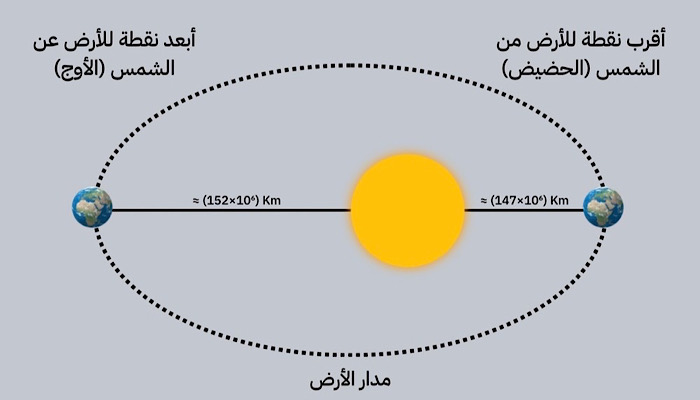

As winter settles in for much of the Northern Hemisphere, an interesting astronomical event is approaching. On Saturday, January 3, 2026, Earth will reach perihelion, its closest point to the Sun in its annual orbit. This predictable event, while often misinterpreted, offers a fascinating glimpse into the mechanics of our solar system and the factors that truly govern our seasons.
Understanding Perihelion: Earth’s Closest Approach to the Sun
The moment of perihelion occurs when Earth is approximately 147.1 million kilometers (91.4 million miles) from the Sun, or about 0.9833 astronomical units. Put simply, it’s around 3 million miles closer than the average distance. This information comes from the Oman Astronomical and Space Society, where Vice Chairman Ibrahim bin Mohammed Al-Mahrouqi explains this isn’t a unique event, but a regular occurrence each January.
Why Does Earth’s Orbit Vary?
The reason Earth doesn’t orbit the Sun in a perfect circle is due to the orbit’s eccentricity, which is about 0.0167. This slight oval shape, predicted by Kepler’s laws of planetary motion, means the distance between Earth and the Sun fluctuates throughout the year. Conversely, Earth reaches its farthest point, known as the aphelion, in early July at around 152.1 million kilometers. The total difference between these two points is roughly 5 million kilometers.
Does Perihelion Affect Our Weather? The Myth Debunked
A common misconception is that perihelion is responsible for warmer temperatures. However, Al-Mahrouqi emphasizes this is incorrect. Earth’s proximity to the Sun has no *direct* impact on our weather or the changing seasons. The primary driver of seasonal variations is the axial tilt of our planet – the 23.5-degree inclination of Earth’s rotational axis relative to its orbital plane.
Imagine Earth spinning like a top. If the top spun perfectly upright, there would be little variation in sunlight throughout the year. But because it’s tilted, different parts of the planet receive more direct sunlight at different times. This is why we experience summer and winter.
How Axial Tilt Creates Seasons
During the summer months, the Northern Hemisphere is tilted towards the Sun, resulting in more direct sunlight, longer days, and concentrated solar energy. This leads to warmer temperatures. In the winter, the Northern Hemisphere is tilted away from the Sun. Consequently, sunlight arrives at a shallower angle, days are shorter, and the energy is spread over a larger area, causing cooler temperatures. The Southern Hemisphere experiences the opposite effect.
The Subtle Influence of Earth’s Orbit & Orbital Speed
While the axial tilt is the major player, the change in Earth-Sun distance during perihelion does have a minor effect. Solar radiation increases by about 7% at its closest point. Interestingly, this happens during the Northern Hemisphere’s winter, which somewhat offsets the shorter days and increases the Earth’s orbital speed according to Kepler’s laws.
This subtle impact is more noticeable in the Southern Hemisphere. Their summers tend to be slightly warmer, and their winters a little milder compared to the Northern Hemisphere. However, even this difference is relatively small and overshadowed by the dominant influence of Earth’s axial tilt. Understanding seasonal changes requires recognizing the interplay of these factors but prioritizing the axial tilt as the key determinant.
Beyond the Science: Promoting Astronomical Awareness
Al-Mahrouqi concludes that events like perihelion are ideal opportunities for public outreach and education. They allow scientists and enthusiasts to dispel common myths about space and astronomy while simultaneously showcasing the incredible precision and harmony within our cosmic system. Explaining these celestial mechanics highlights how consistently the laws of physics govern the movement of planets and stars.
These celestial phenomena, although subtle in their immediate impact on daily life, are crucial to understanding the complex workings of our universe. Observing and studying these events, like the upcoming perihelion, continues to enrich our understanding of the Sun-Earth connection and inspire a greater appreciation for the cosmos. Keep an eye on January 3, 2026, not for a noticeable change in temperature, but for a reminder of the elegant dance that keeps our planet in orbit and defines our seasons.