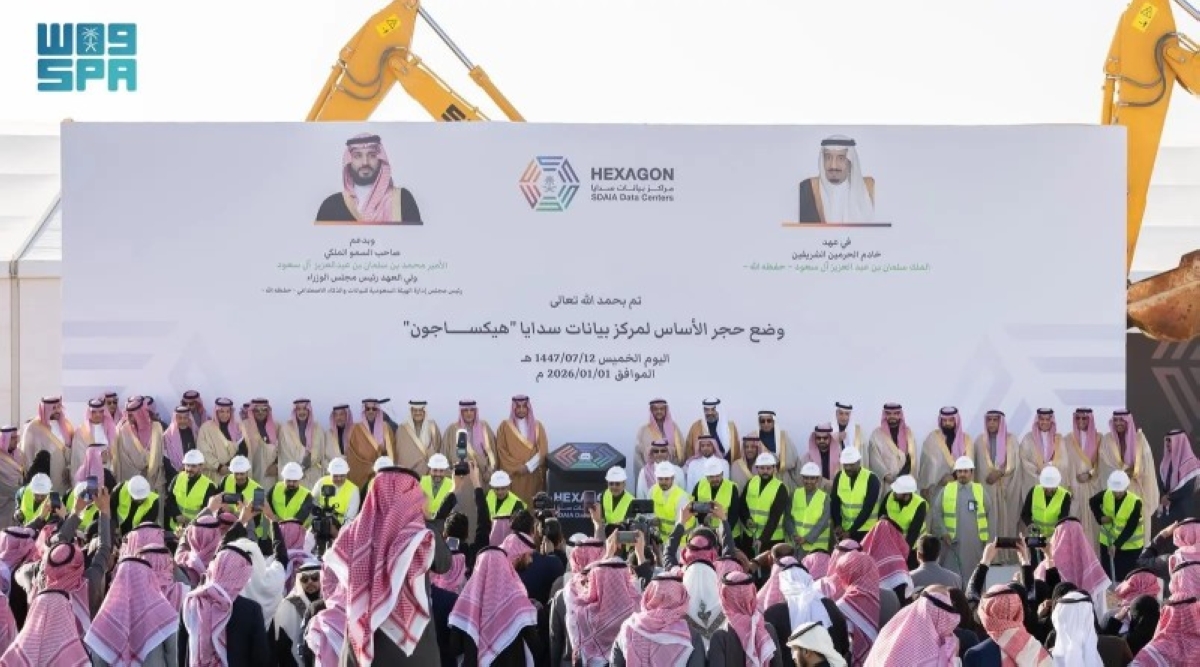

Riyadh, Saudi Arabia – The foundation for the Saudi Data and Artificial Intelligence Authority (SDAIA) “Hexagon” data center was laid on Thursday, marking a significant step in the Kingdom’s ambition to become a global hub for digital innovation. Located in Riyadh, the facility, once complete, is projected to be the world’s largest government data center based on power capacity. The project represents a major investment in Saudi Arabia’s digital infrastructure and its commitment to leveraging advanced technologies.
The groundbreaking ceremony was attended by SDAIA President Dr. Abdullah Alghamdi, SDAIA officials, and representatives from various Saudi government entities. Dr. Issam Alwagait, Director of the National Information Center at SDAIA, presented an overview of the project’s design, technical specifications, and operational framework, emphasizing its robust security and availability features. A supporting exhibition showcased the center’s developmental phases and planned technological environment.
The “Hexagon” Data Center: A Cornerstone of Saudi Arabia’s Digital Future
This massive undertaking aims to strengthen Saudi Arabia’s national economy and solidify its standing within the rapidly evolving global digital economy. Classified as Tier IV by the Uptime Institute—the highest possible rating—the Hexagon data center will boast a total capacity of 480 megawatts, spread across an expansive 30 million square feet. Such a substantial capacity is designed to meet the escalating demands of government digital services and support wider adoption of emerging technologies.
Project Specifications and Global Standards
The center’s design incorporates international best practices to maximize uptime, security, and operational efficiency. According to SDAIA, the project has already secured key international accreditations validating its engineering and solutions. This commitment to globally recognized standards signals a desire to establish a facility competitive on the world stage.
The development speaks to a broader trend of government investment in advanced digital infrastructure. Saudi Arabia, like many nations, recognizes the strategic importance of secure, high-capacity data storage and processing capabilities in an increasingly interconnected world. This investment is not solely focused on internal efficiency but also on attracting foreign investment and fostering a thriving technology sector.
Alignment with Saudi Vision 2030
Dr. Alghamdi emphasized the project’s direct link to the ambitious goals of Saudi Vision 2030, which seeks to diversify the Kingdom’s economy and establish a sustainable, knowledge-based future. The data center is positioned as a critical enabler for advancements in artificial intelligence (AI) and other cutting-edge technologies. He further stated that the Crown Prince’s ongoing support is instrumental in enabling SDAIA to lead the nation’s transformation.
The Authority plans to leverage the capabilities of the Hexagon data center to spearhead new initiatives in data analytics, machine learning, and other AI-driven applications. This expanded capacity will allow for greater exploration of big data opportunities, potentially leading to improvements in public services, economic forecasting, and scientific research.
Economic and Environmental Impacts
Beyond its technological implications, the SDAIA data center project is expected to have a significant positive economic impact. SDAIA estimates the project will contribute approximately SR10.8 billion (roughly $2.88 billion USD) to the nation’s GDP. Additionally, the design prioritizes sustainability, aiming to reduce carbon emissions by approximately 30,000 tons annually.
However, the exact economic benefits and emissions reductions are projections that will depend on factors such as long-term operational costs, the uptake of new services, and the overall trajectory of the Saudi economy. Unforeseen geopolitical or economic shifts could also impact the project’s outcome.
The advancement of cloud computing and edge computing are also factors to consider, though the SDAIA has not explicitly detailed how these technologies will intersect with the Hexagon data center. It is likely these will play a role in optimizing resource utilization and ensuring efficient delivery of digital services across the Kingdom.
Currently, there is no definitive timeline for the completion of the Hexagon data center, although SDAIA officials have expressed a commitment to accelerating the development process. Future announcements are expected to outline construction milestones and anticipated operational dates. Experts will be closely watching the project’s progress, as well as the broader evolution of Saudi Arabia’s digital infrastructure initiatives, to assess the Kingdom’s positioning in the global tech landscape.
The industry will also be observing the details of data governance and security protocols implemented within the center, areas of increasing importance given growing concerns around cybersecurity and data privacy. The successful deployment of the Hexagon data center could serve as a model for other countries seeking to build robust, future-proof digital infrastructure.