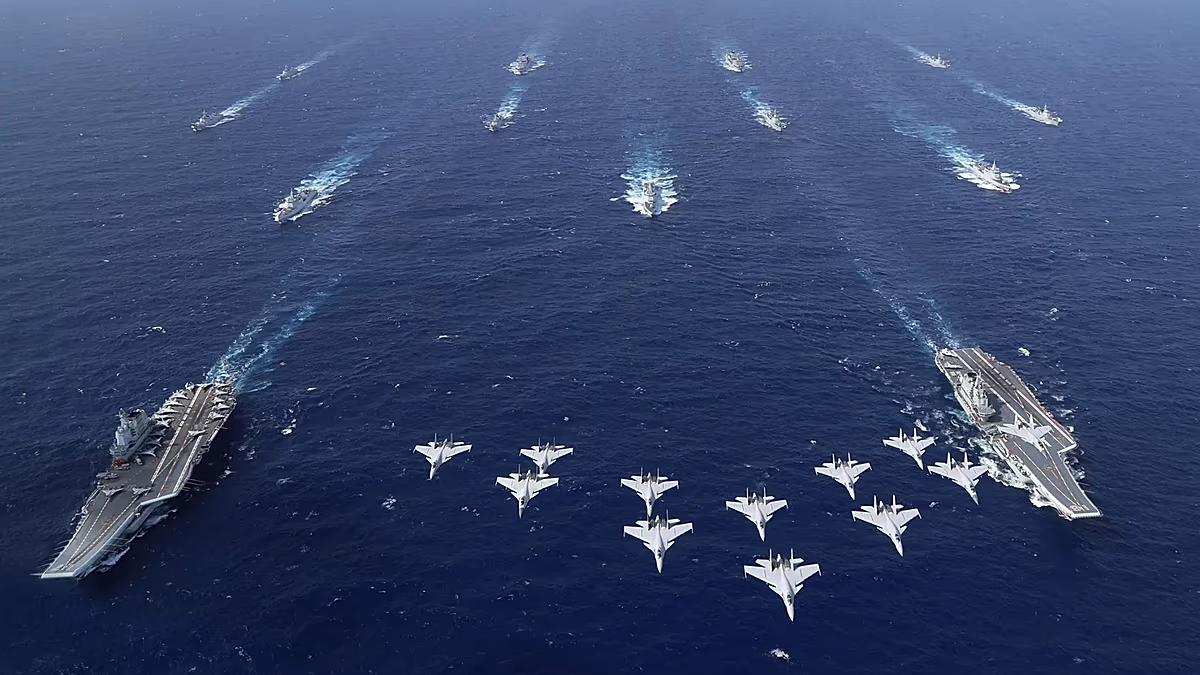

Taiwan’s President Lai Ching-te reaffirmed the island’s commitment to defending its sovereignty amid escalating tensions with China, following recent large-scale military drills conducted by Beijing. Lai’s strong stance, delivered in a New Year’s address, signals a continued focus on Taiwan’s defense and deterrence in the face of perceived threats. The drills were reportedly in response to a planned US arms sale and statements from Japan regarding potential intervention.
The president outlined his plan to bolster Taiwan’s defenses, focusing on strengthening national resilience and building an effective democratic defense mechanism. Lai’s speech came as Chinese leader Xi Jinping stated that Taiwan’s eventual reunification with the mainland is “unstoppable”. These opposing declarations underscore the deepening divide and increased military posturing in the region.
Rising Tensions and Taiwan’s Defense Posture
China views Taiwan as a breakaway province and maintains the option of using force to achieve unification. This principle has been consistently emphasized by Chinese officials, fueling concerns both within Taiwan and internationally about potential military conflict; the latest drills included live-fire exercises and simulated attacks. Taiwan, officially the Republic of China, has been self-governed since 1949, establishing a distinct democratic system and economy.
Beijing expressed its anger over a proposed US arms sale to Taiwan, valued at over $11 billion USD, which includes missiles, drones, and artillery systems. The sale is consistent with the United States’ long-standing policy of providing Taiwan with the means to defend itself. Additionally, China reacted negatively to comments from Japan’s prime minister suggesting Tokyo might intervene in the event of an attack on Taiwan, viewing it as interference in its internal affairs.
China’s Military Demonstrations
The recent two-day Chinese military drills were extensive. They served as a clear demonstration of China’s capabilities and resolve, aiming to intimidate Taiwan and signal its displeasure to Washington and Tokyo, according to analysts. The drills also assessed Taiwan’s response capabilities and potential vulnerabilities.
China’s State Council Taiwan Affairs Office spokesperson, Chen Binhua, harshly criticized Lai, labeling him as a “saboteur of peace, a troublemaker and a warmonger”. This rhetoric highlights the significant gap in perspectives between the two sides and the difficulty of fostering dialogue in the current climate. The exchanges point to an overall hardening of positions.
Taiwan’s Response and Strategic Investments
In response to the growing threat, Taiwan announced a special $40 billion budget for arms purchases. This funding, allocated over eight years from 2026 to 2033, is intended to modernize Taiwan’s armed forces and improve its ability to defend against potential attacks. A key component of this investment is the “Taiwan Dome,” an advanced air defense system designed for high-level detection and interception.
Lai has also committed to increasing defense spending to 5% of Taiwan’s GDP, a substantial increase aimed at bolstering the island’s overall security. This demonstrates a proactive approach to national security and a clear prioritization of defense capabilities. These investments are intended to create a credible deterrent against Chinese aggression.
Meanwhile, the United States State Department has criticized the Chinese drills as unnecessarily escalating tensions in the region. According to spokesperson Tommy Pigott, the US urges Beijing to exercise restraint and engage in meaningful dialogue with Taiwan. The State Department maintains its commitment to the peaceful resolution of cross-strait issues.
The situation underscores the complex geopolitical dynamics surrounding Taiwan, a crucial location in the First Island Chain. The island’s future remains a central point of contention in US-China relations and a key factor in regional stability. Further developments in cross-strait relations, coupled with continued US arms sales, and the development of Taiwan’s military capabilities, will shape the region’s security landscape in the years to come.
As Taiwan continues to build its defense infrastructure and navigate the challenging relationship with China, international observers will be watching closely for further shifts in strategy and potential escalation. Staying informed about these developments is crucial for understanding the evolving security environment in the Indo-Pacific region.
Additional sources • AP