






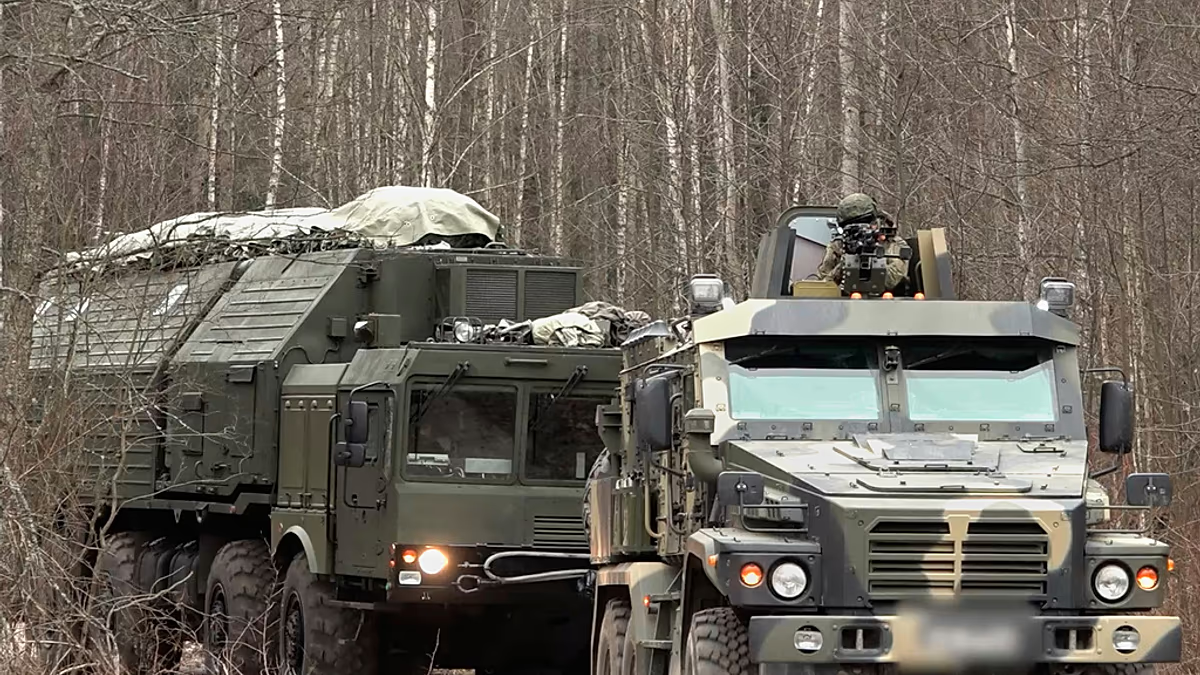

Russia has deployed its new Oreshnik intermediate-range ballistic missile system to Belarus, according to a statement from the Russian Defence Ministry on Tuesday. The move, confirmed by Belarusian President Aliaksandr Lukashenka, introduces a nuclear-capable weapon into the region amid ongoing peace talks regarding the conflict in Ukraine. This deployment raises concerns about escalating tensions and shifts in the nuclear landscape of Eastern Europe.
Footage released by the ministry showed mobile launch vehicles transporting the Oreshnik system through forested areas during training exercises. Lukashenka previously stated that Belarus would receive up to ten of these missile systems, a claim that, if fully realized, would significantly bolster the country’s military capabilities and its alignment with Russia.
What is the Oreshnik Missile System?
The Oreshnik, meaning “hazelnut tree” in Russian, is an intermediate-range ballistic missile identified by the U.S. Department of Defense as a variant of the RS-26 Rubezh. The Pentagon characterizes it as an “experimental” system potentially derived from a previously shelved intercontinental ballistic missile program. Western analysts believe the system was created by modifying the RS-26, removing a booster stage to reduce its overall range.
The missile itself is approximately 15 to 18.5 meters long and has a diameter of around 1.9 meters. It is designed for mobile deployment, utilizing a transporter-erector-launcher (TEL) to facilitate rapid relocation and concealment. According to Belarusian officials, the Oreshnik has a range of up to 5,000 kilometers, placing much of Europe within its potential reach.
Russian state media claims the missile could reach targets in Poland within 11 minutes and NATO headquarters in Brussels in 17 minutes, though these assertions have not been independently verified. Intermediate-range missiles, with ranges between 500 and 5,500 kilometers, were previously prohibited under the now-defunct Intermediate-Range Nuclear Forces Treaty (INF) between the United States and Russia.
First Combat Use and Capabilities
Russia first utilized the Oreshnik in a combat scenario on November 21, 2024, targeting the PA Pivdenmash facility in Dnipro, Ukraine. The launch originated from the Kapustin Yar training ground in Astrakhan Oblast, roughly 800 kilometers from the target. Ukrainian officials reported that the missile carried non-explosive, or “dummy,” warheads.
While U.S. experts described the strike as an “expensive way to deliver not that much destruction,” they acknowledged that even inert warheads traveling at hypersonic speeds can inflict substantial damage through kinetic energy. Satellite imagery indicated limited damage to the Pivdenmash facility, suggesting a focus on demonstrating accuracy rather than destructive power.
The attack was framed by Russian President Vladimir Putin as a “successful test” and a warning to the U.S. and the UK, particularly in light of discussions about providing Ukraine with longer-range weaponry. Moscow reportedly informed Washington of the impending strike beforehand. Ukrainian military intelligence claims to have destroyed one Oreshnik system at Kapustin Yar, leaving two operational.
Putin has stated that Russia would allow Belarus to determine targets for the Oreshnik missiles, and that closer proximity to Belarus would enable the use of heavier payloads. This decision is linked to a revised Russian nuclear doctrine released in 2024, which considers any conventional attack on Russia supported by a nuclear power as a joint attack, and places Belarus under the Russian nuclear umbrella. Reuters provides further details on this doctrine.
Russia had previously deployed tactical nuclear weapons to Belarus, a move that occurred before Belarus served as a launchpad for the full-scale invasion of Ukraine in February 2022. Lukashenka has indicated that Belarus currently possesses several dozen Russian tactical nuclear weapons.
Belarus has faced significant Western sanctions due to its human rights record and its support for Russia’s military actions in Ukraine. The deployment of the Oreshnik system is likely to further strain relations with the West and increase international scrutiny of the country’s military activities.
The situation remains fluid as US-led peace talks continue, though significant disagreements persist between Moscow and Kyiv regarding the Donbas region and the Zaporizhzhia nuclear power plant. The presence of these advanced missile systems adds a new layer of complexity to the ongoing negotiations and the broader security landscape in Europe. Monitoring the further deployment and potential use of the Oreshnik will be crucial in assessing the evolving dynamics of the conflict and its implications for regional stability.
Video editor • Rory Elliott Armstrong
Additional sources • AP