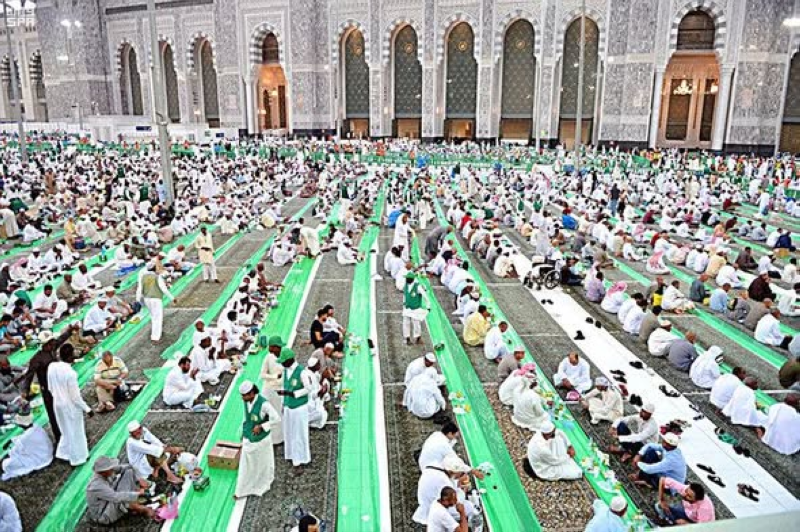

The General Authority for the Care of the Affairs of the Grand Mosque and the Prophet’s Mosque has begun accepting applications from qualified companies and factories to provide iftar meals during Ramadan 1447 AH. This initiative aims to streamline and enhance the distribution of food to worshippers breaking their fast at the holy sites in Makkah and Madinah. Applications are currently open and will be accepted until December 30th, 2023.
The announcement, made recently, applies to organizations seeking to offer iftar services within the Grand Mosque and the Prophet’s Mosque. The authority emphasizes a focus on quality control and logistical organization to ensure a dignified and efficient experience for those observing Ramadan. This is a recurring process, but the specific requirements and timelines are updated annually.
Requirements for Iftar Meal Providers
The authority has outlined a stringent set of criteria for potential providers. These requirements are designed to guarantee food safety, hygiene, and the ability to meet the substantial demand during the holy month. Successful applicants will play a crucial role in supporting the millions of pilgrims and worshippers who visit the Two Holy Mosques each Ramadan.
Essential Documentation and Licensing
Companies and factories must possess a valid commercial registration within the Kingdom of Saudi Arabia. Furthermore, a current municipal license or a license issued by the Saudi Food and Drug Authority (SFDA) for a food preparation facility located in either Makkah or Madinah is mandatory. This ensures compliance with local regulations and food safety standards.
Proof of a physical operating location is also required, either through ownership documentation or a notarized lease agreement. This demonstrates a commitment to local operations and facilitates oversight by the General Authority. The authority will verify the legitimacy of all submitted documentation.
Operational Capacity and Health Standards
Applicants are expected to demonstrate a proven track record of public health compliance. A clean public health record is a non-negotiable requirement, reflecting the sensitivity of providing food to a large and diverse population. The authority will conduct thorough inspections to verify these standards.
Crucially, providers must adhere to specific meal specifications approved by the SFDA. These specifications likely cover nutritional content, ingredients, and preparation methods, ensuring the Ramadan meals are suitable for consumption by a wide range of individuals. Additionally, companies must be capable of producing and delivering a minimum of 10,000 meals per day to meet the anticipated demand.
The scale of Ramadan catering at the Two Holy Mosques is immense, requiring significant logistical capabilities. The authority’s emphasis on a minimum meal quantity reflects the need for providers who can reliably contribute to the overall effort. This also suggests a preference for larger, established food service operations.
The Importance of Organized Iftar Services
Providing iftar, the meal that breaks the daily fast, is a deeply rooted tradition during Ramadan, particularly in the Islamic holy cities. The General Authority’s proactive approach to organizing these services is vital for maintaining order and ensuring the well-being of worshippers. Historically, unregulated distribution of food has sometimes led to congestion and potential hygiene concerns.
The initiative also aligns with Saudi Arabia’s broader Vision 2030, which prioritizes enhancing the experience of pilgrims and visitors to the Kingdom. Improved food distribution during Ramadan is seen as a key component of this effort. The Kingdom invests heavily in infrastructure and services to accommodate the massive influx of people during the holy month.
Furthermore, the standardized requirements imposed on providers contribute to a higher quality of food served. The SFDA’s involvement ensures that meals meet stringent safety and nutritional standards, protecting the health of those who partake. This is particularly important given the large number of individuals fasting and the potential for dehydration.
The process of applying and being selected as an iftar provider is competitive. The authority likely evaluates applications based on factors beyond the basic requirements, such as experience with large-scale food service, logistical planning, and adherence to sustainability practices.
The deadline for submitting applications is Rajab 10, 1447 AH, which corresponds to December 30, 2023. Interested companies and factories are strongly encouraged to review the complete terms and conditions available on the authority’s website before applying. The website address for submissions is https://eserv.alharamain.gov.sa/login.
Following the application deadline, the General Authority will review submissions and announce the selected providers. The timing of this announcement is not yet public. Observers will be watching to see which companies are chosen and how the authority plans to further refine its iftar service organization in the coming years, particularly in light of ongoing infrastructure developments at the Two Holy Mosques.