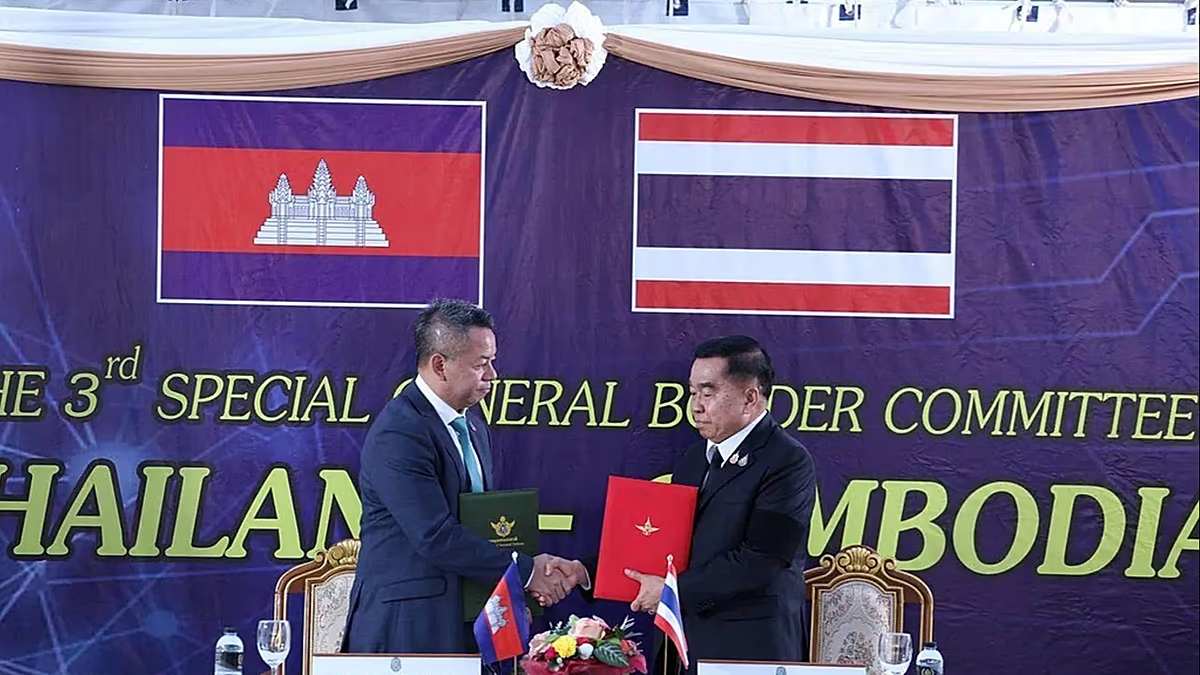

Thailand and Cambodia signed a ceasefire agreement on Saturday, aiming to halt weeks of escalating armed conflict along their shared border. The agreement, which took effect at noon local time, seeks to resolve ongoing disputes over territory and address rising tensions fueled by cross-border crime. This latest development follows previous attempts at de-escalation and international pressure to secure peace between the two nations.
The signing ceremony took place at a border checkpoint, with Cambodian Defence Minister Tea Seiha and Thai Defence Minister Nattaphon Narkphanit representing their respective governments. The agreement stipulates an immediate cessation of military movements and prohibits military airspace violations. A key component of the deal involves Thailand repatriating 18 Cambodian soldiers held as prisoners since earlier clashes in July.
Ceasefire Aims to End Thailand-Cambodia Border Conflict
The renewed fighting, which intensified in early December, stems from a long-standing territorial dispute centered around the area near the Preah Vihear Temple. This UNESCO World Heritage site has been a flashpoint for tensions for decades, with both countries claiming ownership of the surrounding land. Additionally, recent political shifts and economic factors, including concerns over transnational crime, have contributed to the instability.
According to reports, Thailand initiated airstrikes on Cambodian territory as recently as Saturday morning, as confirmed by the Cambodian defence ministry. Both sides accuse the other of initiating the conflict and acting in self-defence. The situation has led to significant displacement, with hundreds of thousands of civilians evacuated from affected areas on both sides of the border.
Casualties and Humanitarian Impact
The conflict has resulted in a growing number of casualties. Thai officials report 26 soldier deaths and one civilian fatality directly linked to the fighting, alongside 44 civilian deaths attributed to collateral damage. Cambodia has confirmed 30 civilian deaths and 90 injuries, but has not released official figures for military casualties.
Beyond the immediate loss of life, the fighting has disrupted communities and hindered economic activity in the border region. The evacuation of civilians has placed a strain on resources and raised concerns about long-term displacement. The ongoing border dispute has also complicated efforts to address the humanitarian needs of those affected.
The agreement also addresses the sensitive issue of landmines. Thai soldiers have been injured in multiple incidents this year, allegedly by newly planted mines originating from Cambodia. Cambodian officials maintain that these mines are remnants of past civil conflicts, which concluded in the late 1990s. Both nations have committed to adhering to international agreements regarding landmine deployment.
Another provision within the ceasefire agreement focuses on information control. Both sides have agreed to “refrain from disseminating false information or fake news,” acknowledging the role of propaganda in exacerbating tensions. This commitment aims to foster a more constructive dialogue and prevent further escalation through misinformation.
Furthermore, the agreement outlines a resumption of previously stalled border demarcation efforts. This process, intended to clearly define the boundary between Thailand and Cambodia, has been hampered by disagreements and security concerns. Cooperation on suppressing transnational crimes, particularly online scams originating in Cambodia, is also prioritized.
Previous ceasefire agreements, brokered in July and formalized in October with the involvement of Malaysia and US President Donald Trump, had failed to fully resolve the underlying issues. Trump had reportedly threatened to withhold trade privileges to encourage a resolution. Despite these earlier efforts, minor clashes and a persistent propaganda war continued to undermine stability.
The success of this latest ceasefire will depend on the full implementation of the agreed-upon de-escalation measures and a sustained commitment to dialogue. Observers will be closely watching the repatriation of the Cambodian soldiers within the 72-hour timeframe and the resumption of border demarcation talks. Continued cooperation on tackling transnational crime will also be a key indicator of improved relations. For the latest updates on the Thailand-Cambodia border situation, stay tuned to reputable news sources.