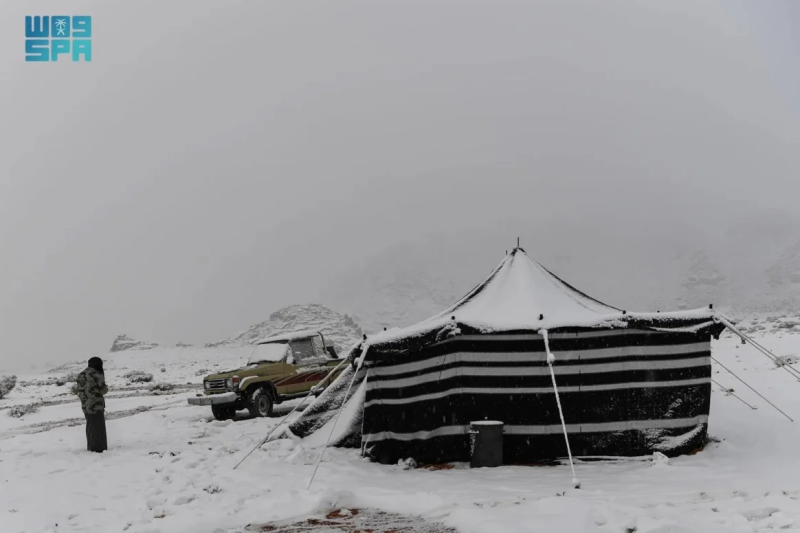

Saudi Arabia has experienced remarkably low temperatures throughout its history, with the National Center for Meteorology (NCM) recently publishing a comprehensive report detailing the coldest recorded temperatures across the Kingdom. The report reveals that the lowest temperature ever officially recorded in Saudi Arabia was a frigid minus 10 degrees Celsius in Hail on January 16, 2008. This data, spanning from 1985 to 2025, provides valuable insight into the country’s climate patterns and potential for extreme weather events.
The NCM’s statistical analysis, released Thursday, examined minimum temperatures and instances of frost during the winter months – December, January, and February – across various regions. The findings highlight significant variations in cold weather experiences, with northern regions consistently reporting the lowest temperatures. This information is crucial for infrastructure planning and public safety measures during the winter season.
Understanding Saudi Arabia’s Coldest Temperatures
According to the NCM report, Qurayyat in the Al-Jouf region came in second place for the lowest recorded temperature, reaching minus 9 degrees Celsius, also in January 2008. Turaif, located in the Northern Borders region, frequently experienced temperatures as low as minus 8 degrees Celsius during the study period. Al-Jouf city itself registered a low of minus 7 degrees Celsius in February 1989.
Several other cities also experienced sub-zero conditions. Arar recorded minus 6.3°C, Rafha reached minus 5.8°C, and even Riyadh, the capital, dipped to minus 5.4°C. Buraidah and Qassim experienced lows of minus 5°C and minus 4.2°C respectively, while Tabuk reached minus 4°C. Further south, Al-Ahsa saw a temperature of minus 2.3°C, with Wadi Al-Dawasir, Taif, and Bisha recording minus 2°C, minus 1.5°C, and minus 1°C respectively.
The Significance of 2008
The report indicates that 2008 was an exceptionally cold year for much of Saudi Arabia. Hail, Riyadh, Buraidah, Qassim, and Tabuk all registered their lowest temperatures on record during that year. The reasons for this particularly harsh winter are still being investigated, but may be linked to larger-scale atmospheric patterns and weather systems.
However, it’s important to note that cold snaps are not uncommon in Saudi Arabia, particularly in the northern and mountainous regions. These events are often associated with the influx of cold air masses from northern and eastern Europe. The NCM’s data helps to establish a baseline for understanding the frequency and intensity of these cold spells.
Frost Days and Regional Variations
The NCM also ranked cities based on the number of days experiencing frost between 1985 and 2025. Turaif topped the list with a substantial 720 frost days, highlighting its consistently cold winters. Qurayyat followed with 588 days, while Hail recorded 339 frost days. Arar and Rafha experienced 277 and 197 frost days respectively.
Meanwhile, cities further south experienced significantly fewer frost days. Sakaka recorded 185, Tabuk 139, Buraidah 83, Al-Qaisumah 71, and Riyadh only 46. This demonstrates a clear gradient in frost occurrence, correlating with latitude and altitude. Understanding these regional differences is vital for agricultural planning and managing potential crop damage due to freezing climate conditions.
Additionally, the NCM’s analysis contributes to a broader understanding of Saudi Arabia’s diverse climatic zones. The Kingdom’s geography, ranging from coastal plains to high mountains and vast deserts, creates a complex interplay of weather patterns. This detailed data is essential for accurate meteorological forecasting and long-term climate modeling.
The NCM emphasized that this report is part of its ongoing commitment to analyzing and documenting long-term climate records. This data supports scientific research, informs infrastructure development, and increases public awareness regarding the Kingdom’s varied climatic characteristics. The information gathered will also be valuable for assessing the potential impacts of climate change on Saudi Arabia’s weather patterns.
Looking ahead, the NCM plans to continue refining its climate models and expanding its network of weather stations. Further research will focus on identifying trends in extreme weather events and improving the accuracy of seasonal forecasts. The next comprehensive report is expected to be released in late 2025, incorporating data collected through the end of the current study period and potentially including analysis of emerging climate trends. Monitoring these trends remains crucial for effective adaptation and mitigation strategies.