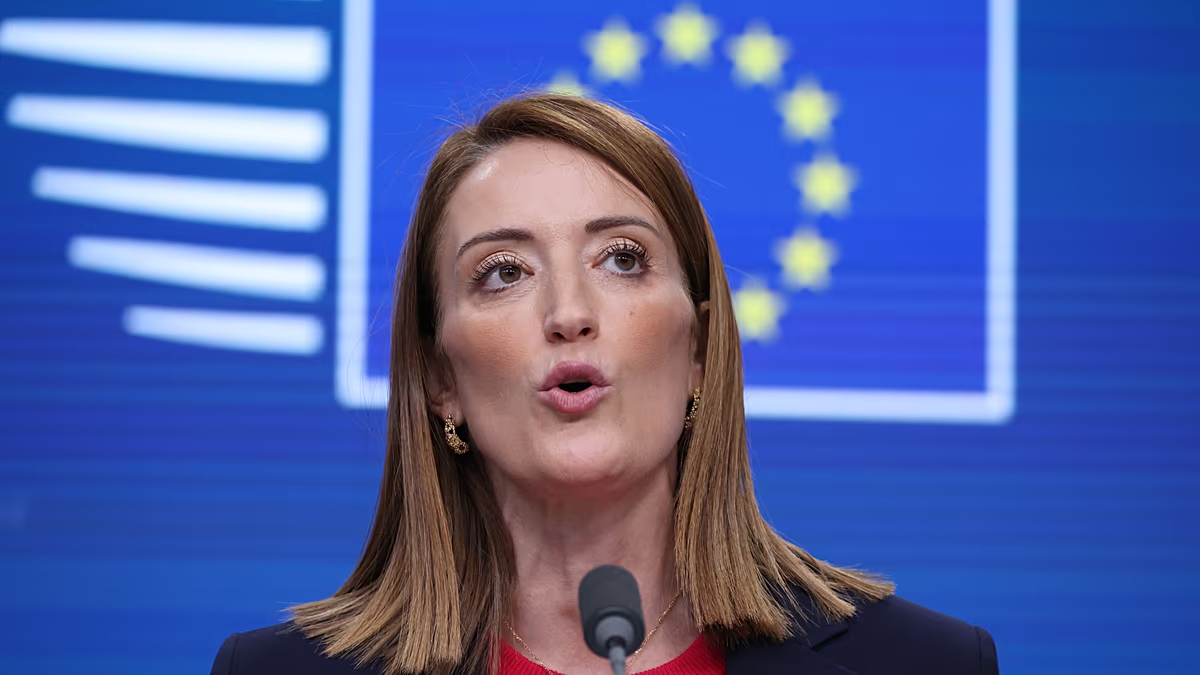

As 2025 draws to a close, the European Parliament has experienced a year of significant shifts in policy and political maneuvering. From multiple attempts to challenge the leadership of the European Commission to a hardening stance on migration and a surprising realignment of political forces, the parliamentary year has been marked by turbulence and change. This article explores the key moments that shaped the European Parliament in 2025, examining the implications for the future of the European Union.
Throughout the year, the Parliament navigated complex issues, including ongoing corruption investigations, internal power struggles, and the evolving geopolitical landscape. These challenges have tested the strength of the EU’s institutions and revealed emerging divisions among its member states, setting the stage for potentially dramatic shifts in the years ahead.
A Year of Challenges for the European Parliament
Several major themes defined the year in the European Parliament. These included a renewed focus on industrial competitiveness, a re-evaluation of the Green Deal, and a growing debate over the balance between national sovereignty and European integration. These issues were often intertwined, creating a complex web of political considerations that shaped the legislative agenda.
Fresh Corruption Scandal Rattles the Institution
A major corruption investigation emerged in March, casting a shadow over the European Parliament. Belgian prosecutors investigated alleged corruption involving Members of the European Parliament (MEPs) and assistants, linked to the Chinese tech company Huawei. The allegations centered around payments, gifts, and invitations used to influence MEPs on issues favorable to the company.
Eight individuals were charged with offenses including corruption and money laundering. Prosecutors requested the lifting of immunity for four MEPs: Salvatore De Meo and Fulvio Martusciello (Italy), Daniel Attard (Malta), and Nikola Minchev (Bulgaria). All four have denied the accusations. The Parliament’s Committee on Civil Liberties, Justice and Home Affairs is currently reviewing these cases, with a decision expected in early 2026. In response, the Parliament barred Huawei lobbyists from its premises in Brussels, Strasbourg, and Luxembourg.
No-Confidence Votes Fail to Dislodge von der Leyen
Members of the European Parliament attempted to topple the European Commission, led by Ursula von der Leyen, with three separate no-confidence votes. While none of the votes succeeded – requiring a two-thirds majority to pass – they signaled significant discontent within the chamber. The first vote, initiated by the European Conservatives and Reformists (ECR) in July, saw 360 MEPs vote against the motion, fewer than the 370 who initially approved the Commission in November 2024.
Notably, some members from the Socialists & Democrats (S&D) and Renew Europe groups abstained, demonstrating their opposition to von der Leyen’s policies without aligning with the far-right. Subsequent votes in October, tabled by the Left and the far-right Patriots for Europe (PfE) groups, garnered stronger support for the Commission, ultimately strengthening von der Leyen’s position. The Parliament demonstrated its power, but ultimately affirmed von der Leyen’s leadership.
Hungary’s Judiciary and Parliamentary Immunity
The year also saw tensions rise over the application of parliamentary immunity to Hungarian lawmakers. Peter Magyar, Klára Dobrev, and Ilaria Salis all faced legal challenges in Hungary, but were protected by their status as MEPs. Magyar faced accusations of defamation and property damage, while Dobrev was also accused of defamation. Salis, an Italian activist, was arrested in Budapest in 2023 following a brawl.
The European Parliament ultimately rejected all requests to lift the immunity of these MEPs in a tense October session. Salis’ case was particularly close, with a 306-305 vote, highlighting deep divisions within the institution. Salis described the outcome as a victory against fascism in Europe.
The EPP’s Shifting Alliances
A significant development in 2025 was the emergence of an informal alliance between the European People’s Party (EPP) and right-wing groups, including the ECR and the far-right PfE and Europe of Sovereign Nations (ESN). This European Parliament realignment saw the EPP, traditionally aligned with centrist forces, collaborate with the right on key legislation, particularly concerning migration and environmental issues.
This shift was evident in the passage of the Omnibus I legislative package, which diluted the EU’s due diligence law. While initially supported by the centrist majority, the package was ultimately approved with the votes of the ECR, PfE, and ESN, demonstrating the EPP’s willingness to seek alternative support. The revised law applies only to larger companies and weakens provisions related to sanctions for non-compliance.
A Harder Line on Migration
In December, the Parliament approved key migration-related legislation, signaling a move towards a more restrictive approach. Changes to the “safe third country” concept will expand the grounds for rejecting asylum applications, allowing for the deportation of asylum seekers to third countries. Additionally, a new EU list of “safe countries of origin” was adopted, including Bangladesh, Colombia, Egypt, India, Kosovo, Morocco, and Tunisia, streamlining asylum procedures for applicants from these nations.
These decisions align with the positions of the Council, indicating a broader shift towards a harder line on illegal migration within the European Union. The implications of these policies will be closely watched in the coming months and years.
Looking ahead, the evolving political landscape within the European Parliament will continue to shape the EU’s legislative agenda. The upcoming elections in France, Italy, and Spain in 2027 will likely further influence the balance of power and the direction of European policy. Staying informed about these developments is crucial for understanding the future of the European Union.