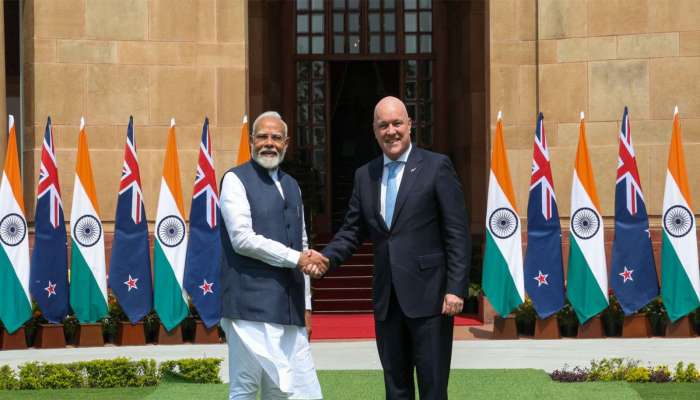

New Delhi witnessed a significant milestone in international trade relations on Monday as Prime Minister Narendra Modi and New Zealand Prime Minister Christopher Luxon jointly announced the landmark India-New Zealand Free Trade Agreement (FTA). This agreement, finalized in record time, is poised to unlock substantial economic benefits for both nations, signifying a strengthening partnership built on shared values and ambitious goals. The unveiling of this FTA marks a new era in bilateral cooperation, fostering greater trade, investment, and opportunities across various sectors.
A Record-Breaking Agreement: Speed and Shared Vision
Negotiations for the India-New Zealand Free Trade Agreement were initiated during Prime Minister Luxon’s visit to India in March and concluded within just nine months – a testament to the political will and shared ambition driving the partnership. Both leaders emphasized that this accelerated timeline reflects a deep commitment to deepening economic ties. This swift conclusion sets a strong precedent for future collaborations and underlines the strategic importance both countries place on this relationship.
The agreement’s rapid finalization belies the thoroughness of the negotiations, which addressed a broad range of issues crucial for sustainable and mutually beneficial commerce. It’s a clear signal of intent to capitalize on the burgeoning economic landscapes of both India and New Zealand.
Boosting Bilateral Trade and Investment
The primary objective of the India-New Zealand Free Trade Agreement is to significantly enhance bilateral trade and investment. Leaders expressed confidence that the FTA will spur a doubling of bilateral trade over the next five years. Furthermore, New Zealand has committed to an impressive USD 20 billion in investment into India over the coming 15 years, mirroring the framework established with the European Free Trade Association (EFTA).
This investment pledge is backed by a crucial rebalancing mechanism. This ensures that if investment targets are not met, trade concessions could be temporarily suspended—incentivizing commitment and accountability from both sides. The FTA isn’t just about eliminating tariffs; it builds a framework for sustained economic engagement.
Expanding Market Access: Goods, Services and More
The FTA encompasses comprehensive collaboration across multiple areas, including goods, services, investment, trade facilitation, and crucially, mobility. New Zealand gains significant access to the Indian market, with tariffs reduced or eliminated on 95% of its exports. Prime Minister Luxon highlighted the potential increase of up to $1.3 billion annually in New Zealand’s exports to India over the next two decades.
India, in turn, will see improved market access to New Zealand in 106 services sectors, alongside Most Favoured Nation (MFN) treatment in an additional 45. Specifically, India’s average MFN tariff of 16.2% will gradually decrease to 9.06% over ten years. While some sensitive sectors such as dairy and certain agricultural products are excluded, the agreement offers substantial gains for both economies. The FTA also fosters trade facilitation, streamlining customs procedures and reducing non-tariff barriers.
A Focus on MSMEs
Recognizing the vital role of Micro, Small and Medium Enterprises (MSMEs), the India-New Zealand Free Trade Agreement includes specific provisions designed to support these businesses. These provisions focus on bolstering cooperation, strengthening business linkages, and improving access to crucial trade-related information. Encouraging MSME participation will ensure a broader distribution of the agreement’s benefits.
Revolutionizing Mobility: Students and Professionals
A standout aspect of this FTA is the groundbreaking agreement on mobility. For the first time, New Zealand has entered into an arrangement with any country offering no numerical caps and guarantees 20 hours of work rights per week for Indian students. This will undoubtedly attract a larger cohort of Indian students seeking quality education in New Zealand.
Moreover, post-study work visas have been generously expanded: three years for STEM bachelor’s graduates, also three for master’s degrees, and up to four years for doctoral studies. A new Temporary Employment Entry Visa pathway will further facilitate the entry of up to 5,000 skilled Indian professionals annually, encompassing key sectors like IT, engineering, healthcare and even traditionally Indian occupations like AYUSH practitioners and chefs. A Working Holiday Visa for 1,000 young Indians annually is also included.
Strengthening the Overall Partnership
Beyond economics, the conversation between the Prime Ministers also highlighted ongoing collaboration in areas like defense, sports, and people-to-people exchange programs. These diverse areas of engagement reinforce the holistic nature of the India-New Zealand relationship. The inclusion of an annex on health and traditional medicine services signifies a unique recognition of India’s expertise in these fields.
Currently, bilateral merchandise trade between the two nations stood at USD 1.3 billion in 2024-25, with total trade in goods and services reaching approximately USD 2.4 billion, driven by a robust USD 1.24 billion in services trade.
In conclusion, the India-New Zealand Free Trade Agreement is a landmark achievement that promises to unlock a new era of prosperity and cooperation. The agreement’s comprehensive scope, ambitious targets, and focus on both economic expansion and people-to-people connections make it a truly progressive and mutually beneficial partnership. As the deal moves toward implementation, businesses and individuals on both sides are encouraged to explore the new opportunities it presents, further solidifying this vital relationship for years to come. This agreement demonstrates a strong commitment to free and fair trade and serves as a model for future bilateral and regional economic collaborations.