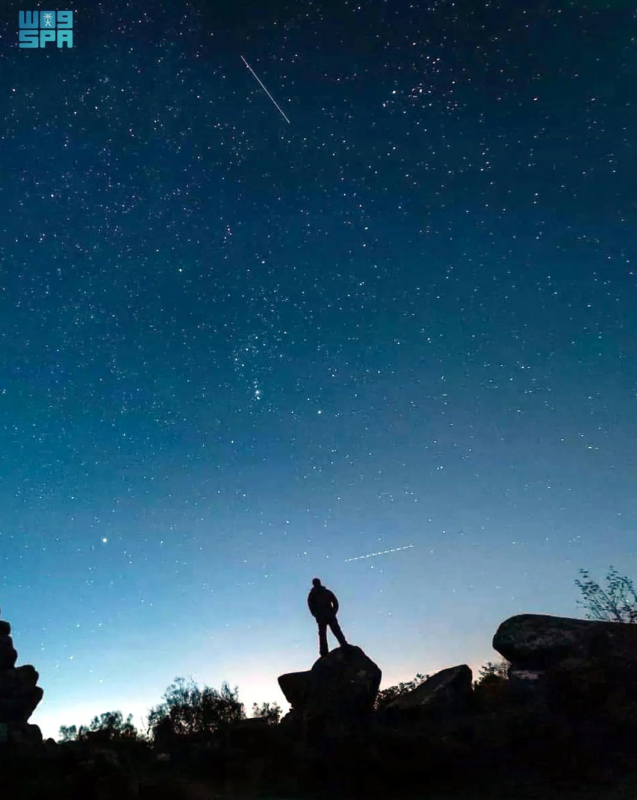

The night sky over the Arab world will be illuminated by the peak of the Ursid meteor shower on the morning of Tuesday, December 23, 2025, coinciding with the winter solstice. This annual celestial event offers a final opportunity for stargazers to observe a significant meteor display before the year’s end. Conditions are expected to be particularly favorable due to a minimal moon presence.
The shower will be visible across the region, including Saudi Arabia, and across the Northern Hemisphere. Astronomers predict that observers can potentially see between five and ten meteors per hour during peak activity. This display is caused by Earth traversing the debris field of comet 8P/Tuttle.
Understanding the Ursid Meteor Shower
The Ursids aren’t a new phenomenon, having been observed annually from December 17th to 25th. The shower derives its name from the constellation Ursa Minor, also known as the Little Bear, as the meteors appear to radiate from this area of the sky. However, viewers don’t need to locate Ursa Minor to enjoy the show; the meteors will appear across much of the visible sky.
Origin and Composition
The Ursid meteor shower is associated with the periodic comet 8P/Tuttle, discovered in 1786. As a comet orbits the Sun, it sheds debris – tiny particles of dust and ice. When Earth passes through these trails, these particles enter our atmosphere at speeds of up to 90,000 miles per hour.
The intense friction caused by this high velocity causes the particles to burn up, creating the bright streaks of light we recognize as meteors. Most Ursid meteors are relatively faint, sometimes appearing as quick flashes. This contrasts with some of the brighter, longer-lasting meteors occasionally seen during other, more active showers.
Viewing Tips for Optimal Observation
To maximize visibility of the Ursid meteor shower, observers should find a location away from city lights. Light pollution significantly diminishes the number of visible meteors. According to Majed Abu Zahra, head of the Jeddah Astronomical Society, the best time to view the peak is in the pre-dawn hours on December 23rd, specifically when the radiant point in Ursa Minor is highest above the northern horizon.
Allowing your eyes to adjust to the darkness for approximately 20-30 minutes is crucial. Avoid looking at bright screens, as this will reset your night vision. No special equipment is required, although binoculars may enhance the viewing experience for some.
Historical Activity and Current Expectations
While the Ursids are a consistent yearly event, their intensity can vary. The nature of the debris stream from comet 8P/Tuttle is thin and fragmented, meaning Earth sometimes passes through less dense areas.
Historically, the shower has experienced occasional outbursts. Notable instances include displays in 1945 and 1986, which saw significantly higher meteor rates. However, in recent years – including observations documented in Saudi Arabia – the Ursids have remained at their typical moderate levels. This makes clear nights particularly treasured by astronomy enthusiasts.
In contrast to the prolific Geminids and Perseids showers, the Ursids are often overlooked. This is largely due to their lower overall activity and the fact that they occur around the winter solstice, when nights are long but temperatures can be cold, potentially discouraging outdoor observation. The Geminids, for example, typically produce over 100 meteors per hour at their peak.
The lack of a bright moon in 2025 forecasts especially good viewing conditions. A full or nearly full moon can wash out the fainter meteors, making them difficult to detect. This year’s early crescent moon won’t pose the same problems, offering a darker canvas for the meteor shower to unfold.
Broader Context: Meteor Showers and Their Science
Meteor showers are a regular occurrence as Earth orbits the sun, intersecting with the orbits of various comets. Understanding these events provides scientists with valuable data about the composition of cometary debris and the dynamics of the solar system. Analysis of meteor composition can reveal clues about the early formation of the planets.
Additionally, observing meteor showers helps refine our knowledge of comet orbits and the distribution of dust particles in space. These particles, while mostly harmless, can pose a minor risk to spacecraft.
The study of meteors and space debris is an active field of research, utilizing both ground-based observations and data from satellites. Continued monitoring of meteor showers provides a unique window into the workings of our solar system.
Looking ahead, astronomers will continue to monitor the Ursids for potential future outbursts, although predictions indicate a continuation of the moderate activity seen in recent decades. Detailed observations from the December 23rd peak will be valuable for refining models of the shower’s activity and improving future forecasts. The exact intensity of any given meteor shower remains somewhat unpredictable, dependent on the density of the debris trail as Earth passes through it.