






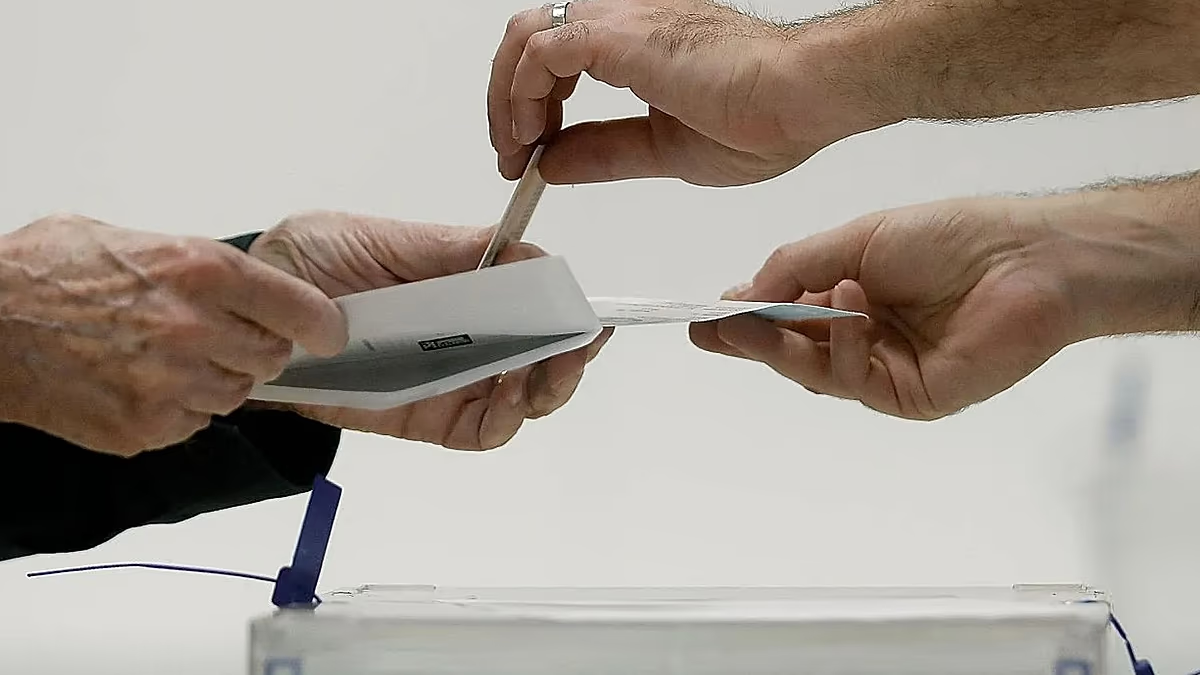

Polling stations in Extremadura are open today for a snap regional election, with over 890,000 registered voters casting their ballots to elect 65 deputies to the Assembly. This election is historically significant as it’s the first time in the region’s democratic history that a vote has been called early and held in December, just before Christmas. The early call came after the regional budget was blocked by a joint amendment from Vox and the PSOE, leading to the dissolution of the Assembly by President María Guardiola.
The political landscape in Spain is closely watching the results of the Extremadura elections, as they are expected to serve as a bellwether for a series of national and regional votes upcoming in 2024 and 2025. Leaders from major national parties have been unusually active in the region during the campaign, recognizing the potential influence of this outcome.
What’s at Stake in the Extremadura Elections?
The main issue driving these elections is the instability within the regional government. The previous coalition faced significant challenges in passing key legislation, culminating in the budget deadlock. This has created a climate where voters are weighing the potential for stable governance against the possibility of continued political maneuvering.
Polls currently favor the People’s Party (PP) to win the largest share of the vote, projected to receive around 41% and secure between 26 and 30 seats. However, the PP is unlikely to achieve an absolute majority, which requires 33 seats. This sets the stage for potential coalition negotiations. Spain has seen increased political fragmentation in recent years, making coalition building increasingly complex.
The Socialist Workers’ Party (PSOE) is predicted to suffer significant losses, potentially falling below 30% of the vote and losing seven seats, ending up with 21. This would mark their worst result in decades in a region traditionally considered a PSOE stronghold. Additionally, Vox is anticipated to consolidate its position and potentially double its representation, gaining between 11 and 13 seats.
The Role of Smaller Parties
Unidas por Extremadura is hoping to improve upon its 2023 performance, with projections suggesting they could gain between 6 and 7 seats. While unlikely to be kingmakers, their support could be crucial in shaping a final governing alliance. The parliamentary arithmetic strongly suggests a PP-Vox coalition would easily command a majority, while a progressive coalition would face an uphill battle.
Turnout and Election Day Incidents
Turnout has been a point of concern. Extremadura has historically maintained high participation rates in elections, rarely dipping below 70% since 1983, although 2019 saw a near-69% turnout. The unusual timing of the election, coupled with the proximity to the Christmas holiday, is expected to potentially affect voter participation.
Reports indicate some minor incidents at the start of the day, including a shortage of polling station officials in certain areas. However, these issues were reportedly resolved by deploying substitute personnel. The Spanish national broadcaster RTVE is providing live coverage of the election throughout the day.
Weather conditions are also playing a part, with parts of Cáceres province on yellow alert for heavy rainfall. The Red Cross has deployed a special transport service with over 50 vehicles to assist elderly, disabled, or ill voters in reaching polling stations. The service can be contacted at 927222222.
The Extremadura elections represent the opening salvo in a busy electoral season for Spain. The outcomes will not only determine the future of the regional government but could also foreshadow the national political climate. Stay informed about the results and analysis as they become available and consider what implications this election might have for the broader political landscape.