






The start of the Islamic month of Rajab is anticipated by many Muslim communities to fall on Saturday, December 16th, 2023, though official confirmation awaits crescent moon sightings. This determination is crucial as Rajab marks a significant period of spiritual preparation leading up to the holy month of Ramadan. The International Astronomical Centre has released predictions regarding crescent visibility, which vary considerably by geographic location.
Rajab is the seventh month in the Hijri, or Islamic, calendar and is considered one of the four sacred months. While not a period of fasting or specific religious obligations like Ramadan, it is a time for increased devotion and reflection for Muslims worldwide. The timing of Rajab is determined by the lunar calendar, making precise date calculations dependent on astronomical observations and religious authority rulings.
Understanding the Rajab Crescent Sighting and Ramadan’s Potential Start
The beginning of Rajab is determined by the sighting of the new crescent moon. According to Engineer Mohammed Shawkat Odeh, Director of the International Astronomical Centre, the central conjunction of the moon – the moment it aligns between the Earth and the Sun – will occur at 01:43 GMT on Saturday. However, this astronomical event does not automatically signify the start of the month.
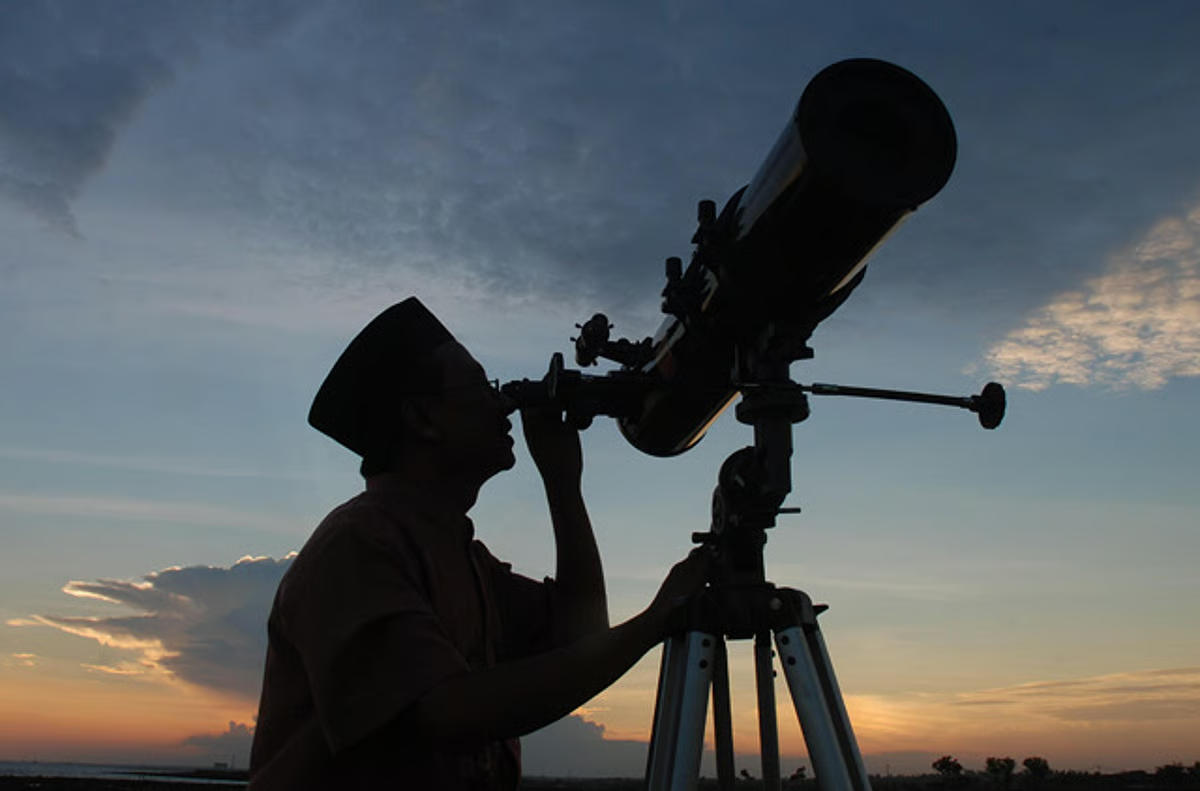
Visibility of the crescent moon after sunset is the key factor, and this is heavily influenced by location. The centre’s calculations indicate that the crescent may be visible with telescopes from parts of southern and south-western Africa, as well as South America. Naked-eye visibility is expected to be limited to western South America and the Pacific Ocean regions.
Regional Variations in Crescent Visibility
Several Arab and Islamic capitals are predicted to have conditions unfavorable for crescent sighting on Saturday evening. In Jakarta, the moon is expected to set just 18 minutes after sunset, at an age of 11 hours and 16 minutes. Similarly, in Abu Dhabi, moonset is predicted 10 minutes after sunset, with the moon being 13 hours and 30 minutes old. Riyadh and Amman are also expected to have very limited viewing windows, with moonset occurring after 11 and 8 minutes respectively.
Cairo and Rabat also present challenges for observers, with moonset occurring after 10 and 12 minutes respectively. Odeh emphasizes that in these locations, conventional methods of sighting the crescent will likely be unsuccessful. These calculations highlight the importance of geographical factors in determining the start of the Islamic lunar months.
More promising conditions are anticipated in Maputo, Mozambique, where the moon is expected to set 39 minutes after sunset, at an age of 16 hours and 8 minutes. This timeframe allows for potential observation with telescopes.
While advanced astronomical imaging can theoretically detect the crescent across a wider area, Odeh notes that these methods are often subject to religious debate and are not universally accepted for officially declaring the start of a new month. The shortest moonset interval ever observed with the naked eye was 29 minutes, and the youngest visible crescent was recorded at 15 hours and 33 minutes, demonstrating the narrow window for successful sightings.
Despite these astronomical predictions, the official commencement of Rajab ultimately rests with the confirmation of religious authorities in each country, based on verified reports of crescent sightings. This process underscores the blend of scientific observation and traditional practice within the Islamic calendar.
The timing of Rajab is of particular interest as it provides an approximate timeframe for when Ramadan might begin. If Rajab and the subsequent month of Sha’ban each last their typical 29 or 30 days, Ramadan could fall around the beginning of March 2024. However, this is a preliminary estimate, and the actual date will depend on the sighting of the next new crescent moon.
The anticipation surrounding the Hijri calendar and the determination of key dates like the start of Rajab, and subsequently Ramadan, are met with dedicated observation by communities globally. Some communities prioritize global uniformity, relying on coordinated sightings and astronomical data, while others adhere to local observations. This difference in approach can sometimes lead to variations in the start dates observed across the Islamic world.
Looking ahead, all eyes will be on the moon sighting reports following the predicted start of Rajab. The confirmation of Rajab’s beginning will then set the stage for observing Sha’ban, and ultimately, determining the precise date for the commencement of Ramadan in 2024. The exact date remains subject to change based on actual observations and the rulings of religious authorities, making continued monitoring essential.