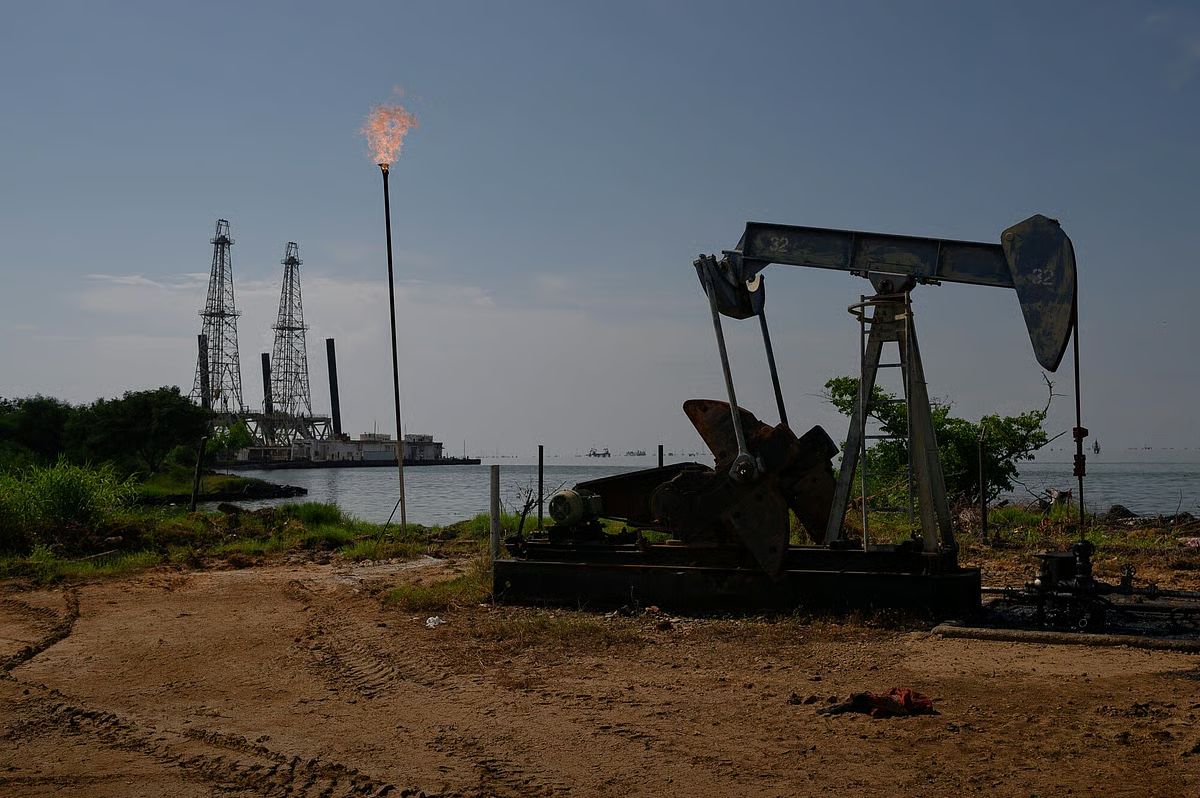

Oil prices surged Monday after former U.S. President Donald Trump ordered a naval blockade of Venezuela, threatening to intercept shipments to Cuba and Nicaragua. Brent crude, the international benchmark, rose more than 4% to over $83 per barrel, while West Texas Intermediate (WTI) climbed above $79 a barrel. This oil price increase reflects market concerns about potential supply disruptions stemming from the escalating tensions in the region and the possibility of wider impacts on global energy markets.
The directive, announced on Trump’s social media platform, targets tankers bound for Cuba’s state oil company, Cubapetrol, and Nicaragua’s Albanisa. Though lacking the legal authority to unilaterally order such an action as a former president, Trump’s pronouncements regularly move markets. The timing coincides with Venezuela’s preparations for presidential elections later this year, a process the U.S. has already indicated has irregularities.
Understanding the Impact on Oil Markets
The immediate effect of Trump’s statement was a significant boost to oil prices. Traders reacted to the renewed geopolitical risk, anticipating potential limitations on Venezuelan oil exports. Venezuela possesses some of the world’s largest proven crude oil reserves, but production has been severely constrained for years due to economic mismanagement, sanctions, and infrastructure decay.
Despite these constraints, Venezuela has been steadily increasing its oil production in recent months, primarily shipping to countries willing to bypass U.S. sanctions. Cuba and Nicaragua have become significant destinations for Venezuelan oil, providing crucial energy supplies for their economies. According to reports from the U.S. Energy Information Administration, Venezuela’s oil output averaged around 810,000 barrels per day in March, a notable rise from previous years.
The U.S. Position and Sanctions
The United States first imposed comprehensive sanctions on Venezuela’s oil sector in 2019, following disputed presidential elections that saw the ouster of then-President Nicolás Maduro. These sanctions aimed to cripple the Maduro regime’s access to revenue and pressure it into holding fair elections. However, the sanctions also contributed to a significant decline in Venezuelan oil production and exacerbated the country’s economic crisis.
The Biden administration has taken a more flexible approach, granting temporary licenses to companies to resume limited oil imports from Venezuela, primarily to alleviate global energy concerns sparked by the war in Ukraine. However, these licenses have frequently been subject to renewal conditions tied to political progress in Venezuela. This has created an environment of uncertainty for international oil companies operating in the country.
Venezuelan Response and Regional Implications
The Venezuelan government, through official channels, has condemned Trump’s announcement as a violation of international law and an act of aggression. While immediate direct military response is unlikely, Caracas is expected to protest the move vigorously through diplomatic channels, leveraging alliances within Latin America. The ministry of foreign affairs released a statement calling the directive “dangerous” and accusing Trump of destabilizing the region.
Neighboring countries and regional organizations such as the Community of Latin American and Caribbean States (CELAC) are closely monitoring the situation. The potential for escalation is a concern, particularly given existing political tensions in the region. Any disruption to Venezuelan oil flows could have knock-on effects for other Latin American economies that rely on Venezuelan fuel.
The Context of Venezuelan Elections
Trump’s announcement directly ties into the upcoming Venezuelan presidential elections, currently scheduled for the second half of 2024. The U.S. government has repeatedly expressed concerns about the fairness and transparency of the electoral process under the current Maduro regime. Concerns center on the disqualification of opposition candidates and restrictions on political freedoms.
However, the Maduro government insists the election will be free and fair, inviting international observers to monitor the process. Recently, the Carter Center, a long-time observer of Venezuelan elections, declined to participate, citing limitations placed on its observation mission. This decision further fueled skepticism about the legitimacy of the vote.
An oil blockade, even if symbolic, could be seen as an attempt to further destabilize the Maduro government and influence the outcome of the elections. Some analysts believe the move is intended to pressure Maduro into allowing a more open and competitive electoral process. Others see it as a continuation of Trump’s longstanding hardline stance against the Venezuelan regime.
Factors Beyond Venezuela Affecting Oil Supply
While the Venezuelan situation is adding a layer of complexity to the global oil supply equation, several other factors are already at play. OPEC+ production cuts, geopolitical tensions in the Middle East, and strong demand from China and India continue to exert upward pressure on prices.
Additionally, concerns about potential supply disruptions due to attacks on Russian energy infrastructure and ongoing conflicts in Ukraine contribute to market volatility. The International Energy Agency (IEA) recently warned that global oil inventories are lower than historical averages, leaving less room for unexpected outages.
In contrast, U.S. oil production has been relatively strong, partially offsetting the declines elsewhere. However, the pace of U.S. oil production growth is expected to moderate in the coming months due to lower drilling activity and logistical constraints.
Looking ahead, the Biden administration is likely to assess the legal ramifications of Trump’s directive and determine its response. The key will be whether the U.S. Navy actually receives orders to enforce such a blockade, which remains uncertain given the legal and political challenges involved. The next significant event to watch will be the Venezuelan government’s announced timeline for responding to the blockade threat. Further escalation could lead to a more significant and sustained increase in oil prices, while a diplomatic resolution would likely ease market anxieties. The possibility of renewed sanctions or further adjustments to existing licensing agreements will also be closely monitored by the energy industry.