






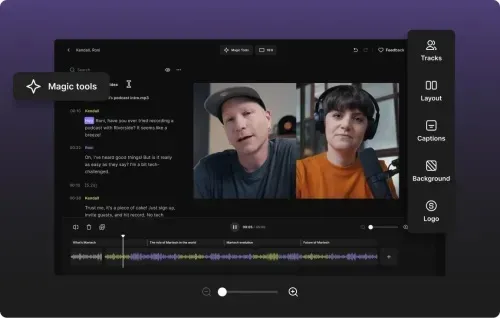

The rise of artificial intelligence continues to reshape digital content creation, and the podcast industry is no exception. Riverside, an online podcast recording platform, recently launched “Rewind,” an AI-powered year-end recap feature for podcasters, mirroring similar offerings from music streaming services like Spotify. While presented as a fun novelty, the tool highlights a growing tension: the increasing, and sometimes questionable, integration of AI into creative workflows.
The AI-Powered Podcast Recap and Its Implications
Riverside’s “Rewind” generates three personalized videos for each podcast. These aren’t data-driven statistics about listenership or recording length. Instead, the feature focuses on moments captured *within* the recordings themselves – a compilation of laughter, a supercut of filler words like “umm,” and a video highlighting the most frequently used word. For some, like a podcast focused on internet culture, the most-used word was surprisingly “book,” likely influenced by subscriber-only content.
The initial reaction to “Rewind” was amusement, as podcasters shared their quirky videos. However, the feature also sparked a broader conversation about the value and potential pitfalls of AI in content creation. While AI can automate tasks like transcription, a crucial element for accessibility, it struggles with the nuanced editorial decisions that define compelling audio storytelling.
AI’s Role in Podcast Production: Automation vs. Artistry
AI-driven transcription services are already widely adopted, significantly reducing the time and cost associated with creating show notes and making content searchable. Additionally, tools are emerging that promise to automate editing tasks, such as removing silences and filler words. However, podcasting relies heavily on the human element – the ability to recognize engaging tangents, maintain a natural conversational flow, and build rapport with an audience.
These are areas where AI currently falls short. A human editor understands context and can discern whether a pause is dramatic or simply awkward. They can identify a funny, rambling aside that should be kept, versus a dead-end conversation that needs to be cut. AI, focused on statistical probability, lacks this critical judgment.
High-Profile AI Failures Raise Concerns
The limitations of AI in creative fields were recently underscored by The Washington Post’s experiment with AI-generated news podcasts. The initiative, intended to automate news delivery, quickly ran into problems. The AI reportedly fabricated quotes and presented factual inaccuracies, raising serious concerns about the reliability of the content.
Internal testing revealed that a substantial portion of the AI-generated podcasts – between 68% and 84% according to Semafor – failed to meet the publication’s journalistic standards. This failure stemmed from a fundamental misunderstanding of how Large Language Models (LLMs) operate. LLMs are designed to generate plausible-sounding text, not to verify truth or distinguish between fact and fiction, particularly in rapidly evolving news cycles.
The Washington Post’s experience serves as a cautionary tale. It demonstrates that while AI can be a powerful tool for automation, it is not a substitute for human oversight, especially when dealing with sensitive information or creative endeavors. The rush to implement AI solutions without careful consideration of their limitations can lead to significant errors and damage credibility.
Despite the setbacks, development of personalized AI audio tools continues, with companies like Google investing in platforms like NotebookLM. These tools aim to provide more tailored experiences, but their ability to truly *create* remains questionable.
Riverside’s “Rewind” is a relatively harmless example of AI integration, offering a lighthearted look at podcasting habits. However, it’s a reminder that AI is rapidly becoming embedded in all aspects of the industry. The challenge lies in harnessing its potential to streamline workflows without sacrificing the artistry and authenticity that make podcasts unique.
Looking ahead, the industry will likely see continued experimentation with AI-powered tools for podcast editing, promotion, and even content generation. The key will be to focus on applications where AI can genuinely enhance the creative process, rather than attempting to replace it entirely. Monitoring the accuracy and reliability of AI-generated content, and establishing clear ethical guidelines for its use, will be crucial in the coming months and years. The long-term impact of AI on the podcast landscape remains uncertain, but a cautious and considered approach is essential.