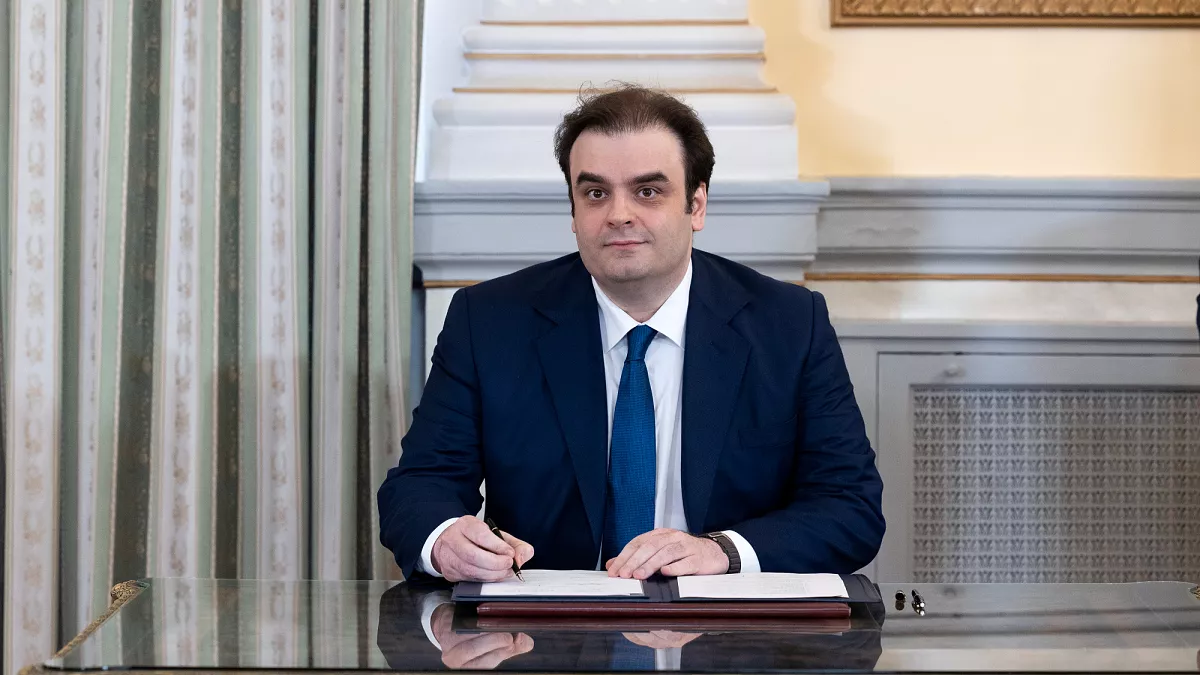

Kyriakos Pierrakakis, Greece’s Finance Minister, was elected president of the Eurogroup on Thursday, marking a significant moment for the country and the wider Eurozone. The election comes a decade after Greece faced a severe debt crisis that nearly forced its exit from the currency union. Pierrakakis will assume his duties on December 12th, succeeding Paschal Donohoe, who left to become President of the World Bank.
Greece’s Pierrakakis Elected to Lead the Eurogroup
The decision to appoint Pierrakakis reflects a growing confidence in Greece’s economic recovery and its commitment to reforms within the European Union. Sources indicated to Euronews that ministers viewed his leadership as a positive signal for the bloc, demonstrating the potential for turnaround even after substantial economic hardship. This appointment underscores the evolving dynamics within the Eurozone, moving away from the crisis-era focus on austerity and towards a more collaborative approach.
The election process wasn’t without its challenges. Vincent Van Peteghem, Belgium’s Budget Minister, also vied for the position. However, his candidacy faced headwinds due to disagreements among member states regarding a proposed reparations loan for Ukraine, a measure Belgium currently opposes.
A Consensus Builder
Despite Van Peteghem’s strong financial background, honed during Belgium’s recent EU presidency, Pierrakakis ultimately emerged as the consensus candidate. Diplomats familiar with the discussions noted that while Van Peteghem was well-respected, Pierrakakis was seen as better positioned to bridge divides within the Eurozone. The vote reportedly resulted in a substantial majority for the Greek minister.
The Eurogroup plays a crucial role in coordinating economic policies among the 20 countries that use the euro. It addresses key issues such as the stability of the European Central Bank’s monetary policy, the development of capital markets, and the implementation of the Banking Union. These areas are increasingly important as the European economy navigates challenges from global competition and geopolitical instability.
Pierrakakis will serve a 2.5-year term, also chairing the European Stability Mechanism (ESM), the Eurozone’s bailout fund. The ESM provides financial assistance to member states experiencing economic difficulties, and its leadership is vital in maintaining the financial stability of the region. The role is particularly significant given ongoing economic uncertainties and the potential for future crises.
In his statement following the election, Pierrakakis emphasized his commitment to fostering greater unity within the Eurozone. He noted a diminishing emphasis on traditional divisions, such as those between northern and southern European economies, as shared challenges become more prominent. He also voiced support for the Draghi Report, a comprehensive analysis of the EU’s economic situation authored by former European Central Bank President Mario Draghi, which calls for significant structural reforms to ensure the bloc’s long-term competitiveness.
Pierrakakis outlined his priorities for the Eurogroup, including advancing the Savings and Investment Union, strengthening the single market, exploring the potential of a digital euro, and bolstering the fiscal foundations of the Eurozone while simultaneously promoting economic growth. These objectives reflect a broader effort to enhance the resilience and dynamism of the European economy in the face of increasing global headwinds, including rising inflation and supply chain disruptions.
Looking ahead, Pierrakakis will be tasked with navigating complex economic challenges and forging consensus among diverse member states. His success will be a key indicator of the Eurozone’s ability to adapt and thrive in a rapidly changing global landscape. Investors and policymakers will be closely watching his approach to these issues as the Eurogroup prepares to address the next phase of economic integration and stability.
Stay informed about the latest developments in European economic policy and the Eurogroup’s initiatives by following reputable financial news sources and the official website of the European Council.