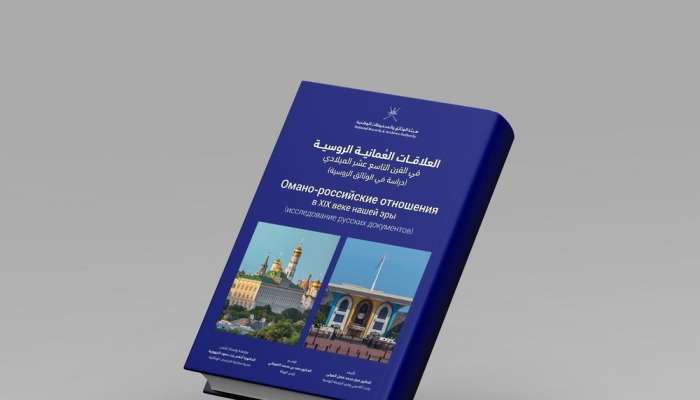

The National Records and Archives Authority (NRAA) of Oman has unveiled a groundbreaking historical publication: “Oman-Russia Relations in the Nineteenth Century AD – A Documentary Study Based on Russian Archives.” This landmark work promises to reshape understanding of the Sultanate’s diplomatic past, offering fresh perspectives on regional history previously overshadowed by European accounts. The release of this study marks a significant contribution to Oman’s history and its positioning within global narratives.
A Deep Dive into Oman-Russia Relations
For decades, scholarship on the Arabian Gulf has largely relied on British and French archival materials. This new publication directly addresses that imbalance, presenting a meticulously curated collection of nearly 2,852 documents drawn from Russian archives. These aren’t simply fleeting mentions; the documents represent an exhaustive compilation of official correspondence, reports, memoranda, detailed cartographic materials, and even historical photographs illustrating the depth of centuries-old ties. The project underscores Oman’s commitment to a more nuanced and complete understanding of its past, leveraging international sources and expertise.
Strategic Significance of Omani Ports
A key finding highlighted by the NRAA is the undeniable strategic importance of Omani ports during the 19th century. The study reveals how these ports were central to the global maritime commerce network of the time, attracting attention and fostering connections with empires far beyond the Arabian Peninsula. Russia’s interest in this network is clearly documented, providing valuable insight into its own imperial ambitions and trade strategies. This challenges conventional narratives and places Oman firmly at the crossroads of international power dynamics.
The Publication’s Structure and Scope
The book is thoughtfully structured into three principal chapters, providing a systematic and comprehensive exploration of Oman-Russia diplomatic ties. The first chapter meticulously traces the progression of diplomatic and trade relations between the two nations. The second chapter offers an analytical overview of Russian political and commercial activities within the wider Gulf region – situating Oman within this larger context. Finally, the third chapter paints a vivid picture of the political, economic, and social landscape of Oman itself during this pivotal period.
Adding significantly to its scholarly value, the publication includes detailed documentary appendices. These feature reproductions of over 50 rare archival records sourced directly from Russian collections. Furthermore, the inclusion of comprehensive indices ensures easy navigation for researchers delving into this invaluable resource. The project has taken a decade to come to fruition, demonstrating a firm dedication to historical accuracy and thoroughness.
Voices from the National Records and Archives Authority
Dr. Hamad bin Mohammed Al Dhoyani, Chairman of the NRAA, emphasized the fundamental aim of the project: illuminating Oman’s rich civilisational narrative through primary sources. “The Russian archives offer unambiguous evidence of the substantial historical relationship between our nations,” he stated, “and vividly illustrate Oman’s considerable political and commercial influence during the 18th and 19th centuries.” This highlights a conscious effort to reassess Oman’s role in history from a new and compelling vantage point.
Dr. Dharar Mohammed Fadhl Al Mawla, the book’s author, further explained the significance of this undertaking. “This book is the fruit of a decade-long endeavour dedicated to the translation and academic verification of rare Russian documents,” he said. The value lies not only in the translated content, but also in the rigorous verification that lends credibility to the findings. This work notably contributes to the field of Gulf historical studies.
Dr. Ahlam bint Hamoud Al Jahwari, Director Specialist for Documentary Studies at the NRAA, added a critical perspective. She described the publication as a “major qualitative addition” to both Arabian Gulf history and modern European history, stressing “systematically introduces a crucial corpus of Russian documents to the Arabic-speaking scholarly world for the first time.” The time period covered, from 1792 to 1917, demonstrates a consistent, evolving relationship, reaffirming Oman’s centrality in historical trade and navigational routes.
A New Era for Historical Research
This publication isn’t intended as a one-off release; it represents the inauguration of a projected series от publications dedicated to exploring Oman’s diverse international engagements. Drawing upon over 300 referenced sources – encompassing documents, visual materials, maps, and personal memoirs – the work offers a solid foundation for future scholarship. The availability of these primary sources will empower researchers to develop alternative narratives and challenge established interpretations.
Ultimately, “Oman-Russia Relations in the Nineteenth Century AD – A Documentary Study Based on Russian Archives” represents a critical step in the NRAA’s ongoing mission to translate and provide global historical records to the Arab research community, all while adhering to the highest international academic standards. The book signals a brighter future for understanding Oman’s historical importance and its place on the world stage.
This invaluable resource is now available and promises to spark new debates and discoveries within the academic community. Researchers and history enthusiasts alike are encouraged to explore the depths of this meticulously researched and presented historical account.