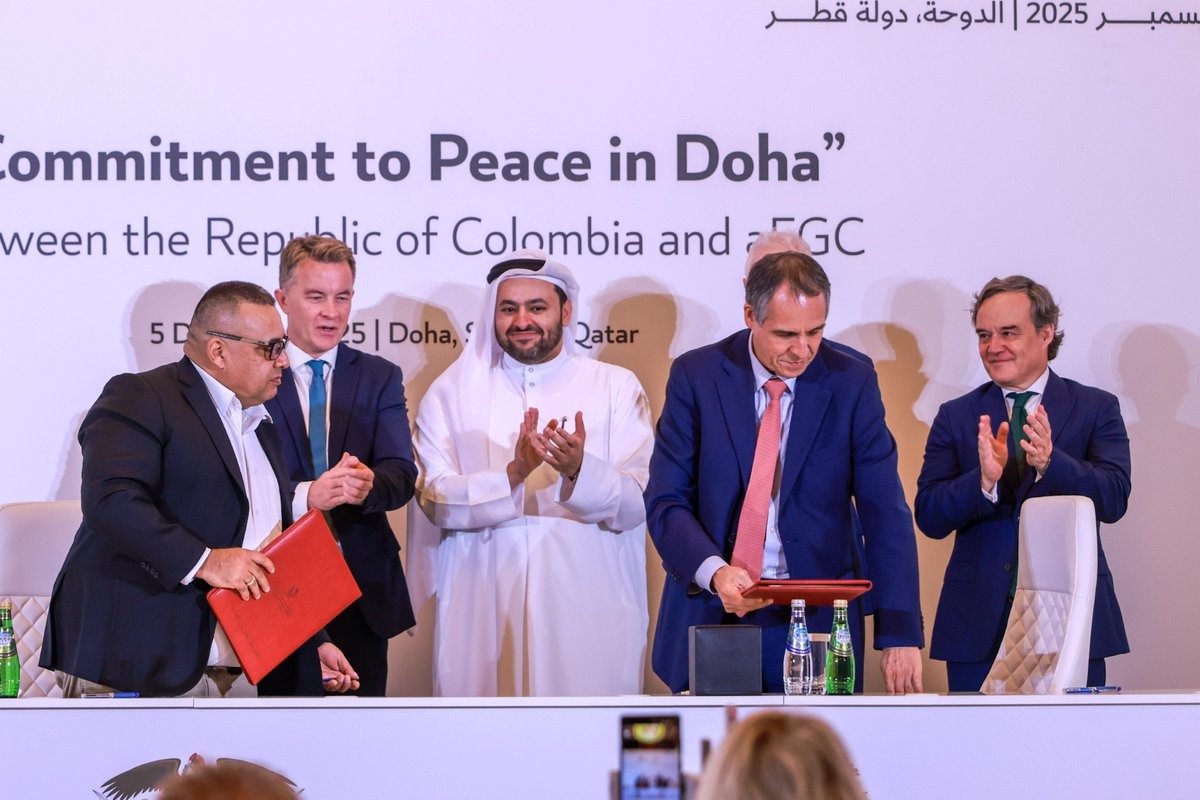

The State of Qatar successfully mediated a “Commitment to Peace” agreement between the Colombian government and the self-designated EGC group on December 5, 2023, in Doha. This agreement, achieved after two rounds of talks, aims to end the armed conflict and alleviate the suffering of civilians affected by the ongoing unrest in Colombia. The signing marks a significant step towards potential long-term peace in Colombia, a goal repeatedly advocated for by international bodies.
The signing ceremony was attended by Qatar’s Minister of State at the Ministry of Foreign Affairs, Dr. Mohammed bin Abdulaziz bin Saleh Al Khulaifi, alongside representatives from key international partner nations including Norway, Switzerland, and Spain. The commitment represents a convergence of interests and a shared responsibility towards resolving the conflict, according to statements released by the Qatari Ministry of Foreign Affairs. This mediation effort underscores Qatar’s increasingly prominent role in international conflict resolution.
Qatar’s Mediation Efforts and the Road to Peace in Colombia
Colombia has faced decades of internal armed conflict, involving various guerilla groups, paramilitary organizations, and the government. This instability has significantly impacted the country’s social and economic development. The current negotiation with the EGC group, previously known as the Gulf Clan, focuses on securing a bilateral ceasefire and implementing comprehensive programs for the civilian population.
The Qatari Ministry of Foreign Affairs highlighted the positive approach taken by both parties throughout the mediation process. They expressed optimism that the “Commitment” would lay the groundwork for tangible progress. According to the ministry, the agreement prioritizes ending violence and addressing the humanitarian needs of communities impacted by the conflict.
The Scope of the Agreement
Details of the “Commitment to Peace” remain limited, but officials indicate it encompasses pledges related to civilian protection, ceasing hostilities, and initiating discussions on broader socio-economic issues. Observers suggest this initial agreement could serve as a framework for more detailed negotiations down the line, addressing the root causes of the conflict and offering opportunities for reintegration of former combatants.
The inclusion of social programs represents a shift in strategy, acknowledging that military solutions alone are insufficient to achieve sustainable peace. These programs will likely focus on areas such as education, healthcare, and economic development, aimed at providing alternative livelihoods and fostering reconciliation.
Qatar’s role wasn’t undertaken in isolation. The presence of Norway, Switzerland, and Spain as international guarantors is seen as crucial to the agreement’s credibility and implementation. Norway has a long history of engagement in the Colombian peace process, while Switzerland has traditionally served as a neutral intermediary. Spain’s involvement reflects growing European interest in stabilizing the region and addressing issues of regional security.
The Ministry of Foreign Affairs specifically thanked these nations for their continuous support and contributions to dialogue, emphasizing that collaborative efforts were instrumental in reaching this milestone. Continued international support is viewed as vital for the long-term success of any peace agreement.
While this commitment is a positive development, significant challenges remain. Previous attempts at negotiating with armed groups in Colombia have faced setbacks due to a lack of trust, ongoing violence, and disagreements over key terms. Successfully navigating these obstacles will require sustained commitment from all parties involved.
Furthermore, the complex political landscape of Colombia, coupled with the presence of other armed groups, could potentially complicate the implementation of the “Commitment.” The Colombian government must demonstrate its capacity to ensure the security of its citizens and enforce the terms of the agreement, despite these existing dynamics. Potential avenues for addressing political dialogue are also anticipated post-agreement.
Looking ahead, the next step involves establishing a timeline for the implementation of the “Commitment to Peace”, including the formalization of a ceasefire and the commencement of social programs. The Qatari government has indicated its readiness to continue facilitating discussions and providing support to the process. Experts will be closely monitoring the situation for signs of a lasting de-escalation of violence and progress towards a comprehensive and inclusive peace settlement in Colombia. Any upcoming deadlines or concrete actions will be crucial indicators of the agreement’s viability.
Full details of the historic agreement can be found on The Peninsula Qatar.