
NATO has affirmed its readiness to defend Europe following stark warnings from Russian President Vladimir Putin about potential conflict. The alliance’s response, delivered after high-level discussions in Brussels, signals a heightened state of alert amid increasing geopolitical tensions. This development underscores a critical moment in European security, as the possibility of a wider conflict looms despite ongoing diplomatic efforts and focus on NATO’s collective defense.
Euronews correspondent Shona Murray, reporting from NATO headquarters, provided an update on the unfolding situation. The discussions centered on Russia’s increasingly assertive rhetoric and its ongoing actions in Ukraine, prompting a firm commitment from NATO to “do what it takes” to safeguard its member states and the broader European continent.
Europe’s Preparedness and Putin’s Warnings
President Putin recently stated Russia was “ready for war” with European countries, though he indicated a preference to avoid direct confrontation. This statement, widely reported, came in response to French President Emmanuel Macron’s ongoing visit to China, where the situation in Ukraine is a key topic of discussion. The Kremlin’s positioning suggests growing frustration with Western support for Ukraine and a desire to signal its willingness to escalate if necessary.
The European Union is also actively working to strengthen its position. Executive Vice-President Roxana Mînzatu, a Romanian politician with extensive experience in European affairs, is focused on bolstering social rights, skills development, and overall preparedness within the EU. These efforts aim to enhance the bloc’s resilience in the face of potential economic and social disruptions stemming from the geopolitical instability.
Meanwhile, French President Macron’s fourth trip to China highlights the importance of maintaining dialogue with key global players. Discussions are expected to cover trade relations, geopolitical strategy, and, crucially, finding a path towards a resolution of the conflict in Ukraine. The visit is seen as an attempt to leverage China’s influence to de-escalate tensions and promote a peaceful outcome.
Eurovision Controversy Adds to Complexities
Beyond the immediate security concerns, Europe is grappling with internal disagreements, as evidenced by the growing controversy surrounding the Eurovision Song Contest. Several countries, including Spain, are considering boycotting the event in protest of Israel’s participation, arguing for consistent application of exclusion criteria similar to those applied to Russia in 2022. This situation demonstrates the challenges of navigating political sensitivities within a cultural context.
The debate over Israel’s participation has sparked widespread discussion about the role of politics in entertainment and the potential for boycotts to exert pressure on international actors. The European Broadcasting Union (EBU), the organization behind Eurovision, is facing increasing scrutiny as it attempts to balance its commitment to inclusivity with the concerns raised by participating nations.
The escalating tensions with Russia, coupled with internal EU debates and diplomatic initiatives like Macron’s visit to China, paint a complex picture of Europe’s current state. The continent is navigating a period of significant uncertainty, requiring a coordinated and resolute response to safeguard its security and promote its interests. The focus on European news is more critical than ever.
The situation remains fluid, and further developments are expected in the coming days. NATO’s continued monitoring of Russian activity, the outcome of Macron’s discussions in China, and the resolution of the Eurovision controversy will all be key indicators of Europe’s trajectory. Stay tuned to Euronews for ongoing coverage and analysis of these critical events, and for the daily updates provided by “Europe Today”.
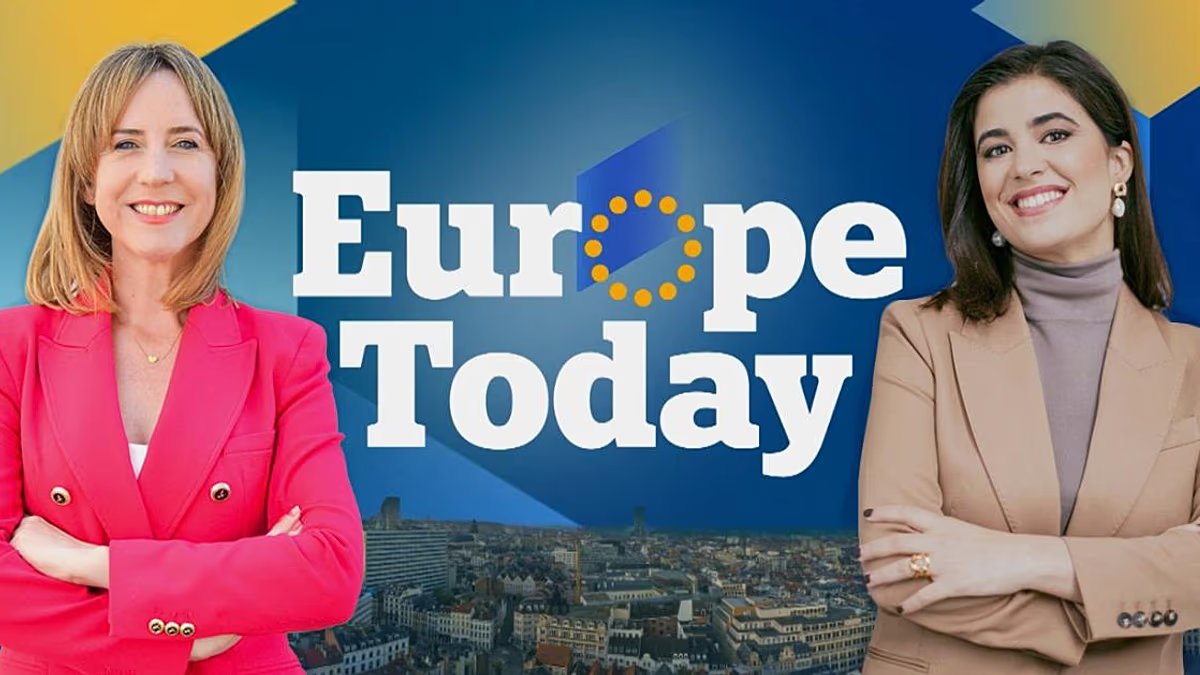
You can join Euronews’ chief anchor Méabh Mc Mahon and EU editor Maria Tadeo every morning at 8:00 CET for “Europe Today”, a new daily show bringing you the latest on these and other important stories shaping the EU and beyond. The show is available on Euronews in English with subtitles in 11 other languages.