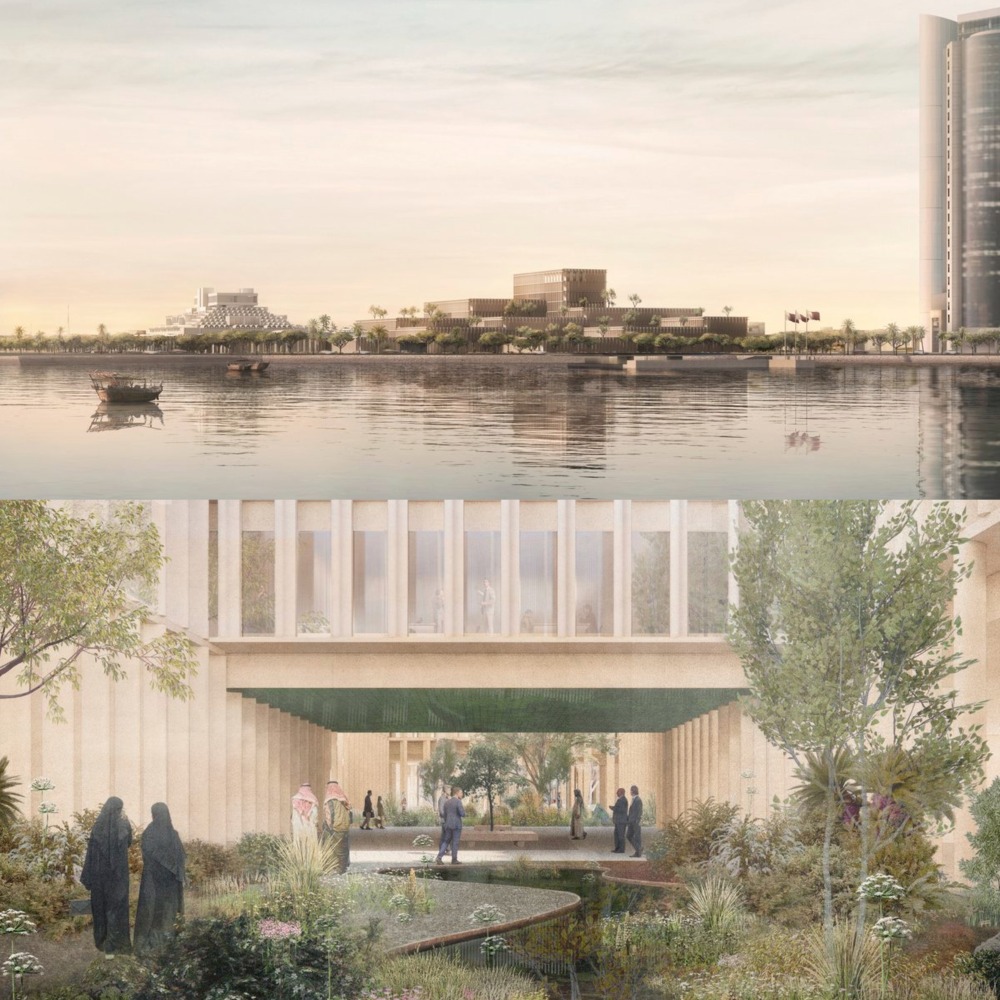

Doha, Qatar – The State of Qatar has announced plans for a new headquarters for its Ministry of Foreign Affairs, a project designed to enhance the nation’s diplomatic presence and public accessibility. The building, located on a key site along Doha’s waterfront Corniche, will serve as a symbol of Qatar’s increasingly prominent role in international diplomacy. The initiative underscores Qatar’s commitment to fostering dialogue and resolving conflicts on a global scale.
The project, revealed today, aims to create a more visible and welcoming civic space for the Ministry, which is widely recognized for its mediation efforts. Construction will involve both new building and the careful preservation of a historic landmark, the 1985 General Post Office. This move reflects Qatar’s broader strategy of balancing modernization with the protection of its cultural heritage.
Frida Escobedo Selected to Design New Ministry of Foreign Affairs Headquarters
Following an international invited competition, the commission to design the new complex has been awarded to Frida Escobedo, founder and principal of Frida Escobedo Studio, based in Mexico City and New York. Escobedo’s firm was chosen from an initial pool of 40 architectural teams, later narrowed to a shortlist of seven, according to Malcolm Reading Consultants, who managed the competition.
The 70,000 square meter (750,000 square foot) complex will rise alongside Doha Bay. The design prioritizes a human scale and incorporates courtyard spaces, aiming to create a rhythmic composition of volumes that connect Qatar’s past with its future. The integration of the General Post Office is a central element of the plan.
Preserving Qatar’s Heritage
The 1985 General Post Office, known for its distinctive modernist “pigeonholes,” will be adaptively reused as a public space dedicated to cultural diplomacy. This preservation effort aligns with Qatar Blueprint, a national initiative focused on urban planning, heritage conservation, and architectural excellence. The ground floor will be transformed into an exhibition space that flows into a covered garden.
According to HE Sheikha Al Mayassa bint Hamad bin Khalifa Al-Thani, Chairperson of Qatar Museums, the project demonstrates a commitment to sustainability and adaptive reuse while creating a new architectural landmark for the country. She emphasized the importance of the project in elevating Qatar’s global position.
Prime Minister and Minister of Foreign Affairs, HE Sheikh Mohammed bin Abdulrahman bin Jassim Al-Thani, expressed gratitude for the vision of His Highness The Amir, stating the new headquarters will be an “icon for the nation’s diplomacy” and a source of national pride. He also thanked Sheikha Al Mayassa for her role in the project and Ashghal, Qatar’s Public Works Authority, for its cooperation.
The design incorporates vertical pillars that provide shade, privacy, and transparency, creating an inviting exterior. Interior spaces will feature green patios intended for reflection, gatherings, and the display of art. This blending of architecture and landscape is intended to create a unique and welcoming environment.
The selection process was intentionally international, with architects from all continents invited to participate, reflecting the Ministry’s global outlook. Frida Escobedo Studio collaborated with Buro Happold engineers and Studio Zewde landscape designers on the winning proposal. The project also aims to boost cultural experiences in the city.
This development is part of a larger trend of investment in Qatar’s infrastructure and its position as a regional and global hub. The new headquarters is expected to further enhance the country’s ability to engage in effective diplomatic negotiations and international cooperation.
The next steps involve finalizing the design details and initiating the construction phase. A specific timeline for completion has not yet been announced, but the project is expected to take several years. Observers will be watching to see how the adaptive reuse of the General Post Office is implemented and how the final design reflects Qatar’s vision for its diplomatic future.