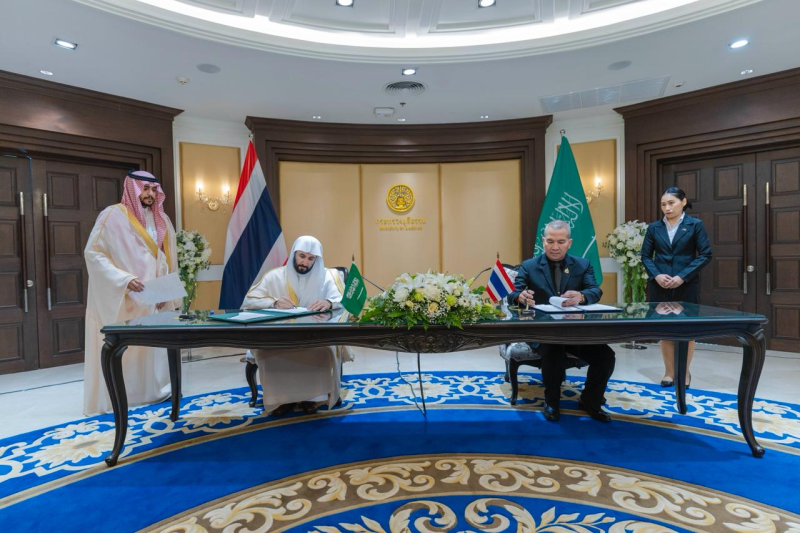

BANGKOK – Saudi Arabia and Thailand have solidified their commitment to strengthening legal ties through a new judicial cooperation agreement signed during a visit by Saudi Minister of Justice Dr. Walid Al-Samaani to Bangkok. The memorandum of understanding (MoU), signed with Thailand’s Minister of Justice Rutthaphon Naowarat, aims to enhance collaboration in legal and judicial matters, fostering modernization and efficiency within both nations’ justice systems. The agreement signals a continued warming of relations between the two countries following recent diplomatic efforts.
The signing ceremony took place on [Date – approximate based on news release, insert actual date if known] in Bangkok and outlines several key areas of collaboration, including the exchange of expertise and information, joint development of judicial systems, and enhanced training for legal professionals. This development builds upon a broader trend of Saudi Arabia actively seeking international partnerships to reform its own legal frameworks. It is anticipated that implementation will begin within the next quarter.
Expanding Judicial Cooperation: Details of the New Agreement
The MoU focuses on several core tenets of judicial cooperation. Specifically, it establishes formalized channels for sharing best practices in areas like court administration, evidence handling, and alternative dispute resolution. This knowledge transfer is expected to contribute to more effective and accessible justice systems in both Saudi Arabia and Thailand. The agreement does not detail specific financial commitments, but rather outlines a framework for future collaboration.
Saudi Arabia’s Recent Legal Reforms
Dr. Al-Samaani’s visit provided an opportunity to highlight Saudi Arabia’s significant ongoing legal reforms. According to the Saudi Ministry of Justice, these reforms are being spearheaded under the direction of King Salman and the oversight of Crown Prince Mohammed bin Salman. These efforts include the development of specialized legislation targeting key sectors of the Saudi economy and society.
Recent changes, documented by international observers, have focused on increasing transparency and predictability in legal proceedings. These include efforts to codify customary law, enhance due process guarantees, and strengthen the rule of law. Additionally, the reforms have sought to streamline court processes, reduce case backlogs, and improve the overall quality of judicial services.
Thailand’s Focus on Modernization
Thailand’s participation in the MoU reflects its own commitment to modernizing its legal and judicial frameworks. The country has been increasingly focused on improving its court efficiency and addressing issues of access to justice, particularly for vulnerable populations. Strengthening international partnerships is seen as a crucial component of achieving these goals.
The Thai Ministry of Justice has previously announced initiatives to leverage technology in court administration and to expand legal aid services. These efforts align with the broader objectives of the MoU, which emphasize the importance of developing innovative approaches to justice delivery. The country is also working to improve its international standing in areas related to human rights and the rule of law.
The discussions between the two ministers also centered on the importance of “preventive justice.” This concept, gaining traction globally, emphasizes proactive measures to address the root causes of crime and reduce the demand for judicial intervention. The agreement will facilitate the exchange of information on successful preventive justice programs implemented in both countries. This includes initiatives focusing on rehabilitation, community policing, and social welfare programs.
A key aspect of the collaboration will be the development of training programs for judicial personnel, to be conducted at the Judicial Training Center in Saudi Arabia. These programs aim to enhance the technical skills and professional capabilities of judges, prosecutors, and other legal professionals, ensuring a consistently high standard of justice administration. Further details regarding the curriculum and scope of these programs are expected in the coming months. Another potential area for collaboration is legal education, fostering closer ties between universities and legal institutions in Saudi Arabia and Thailand.
The agreement highlights the growing bilateral ties between Saudi Arabia and Thailand. These relations have seen a marked improvement in recent years, with increased trade, investment, and cultural exchange. The strengthening of legal collaboration is viewed as a natural extension of this broader partnership, contributing to greater stability and cooperation in the region. This partnership also comes at a time when both nations are seeking to diversify their international relationships.
While the MoU provides a strong foundation for future cooperation, the specific outcomes and timelines for implementation remain to be seen. The success of the agreement will depend on the continued commitment of both governments to allocate resources and prioritize the collaborative initiatives outlined in the document. Observers will be watching for concrete projects and measurable improvements in judicial efficiency and access to justice in both countries. The next step involves the formation of joint working groups to develop detailed action plans based on the MoU’s framework, with an initial progress report anticipated within one year. The impact of this international legal cooperation on specific cases or legal challenges is currently unknown.
Long-term observers suggest further agreements focusing on specific legal challenges such as cybercrime and extradition may follow. The potential for joint research projects on comparative legal systems also exists, ultimately offering benefits to both nations’ judicial systems.