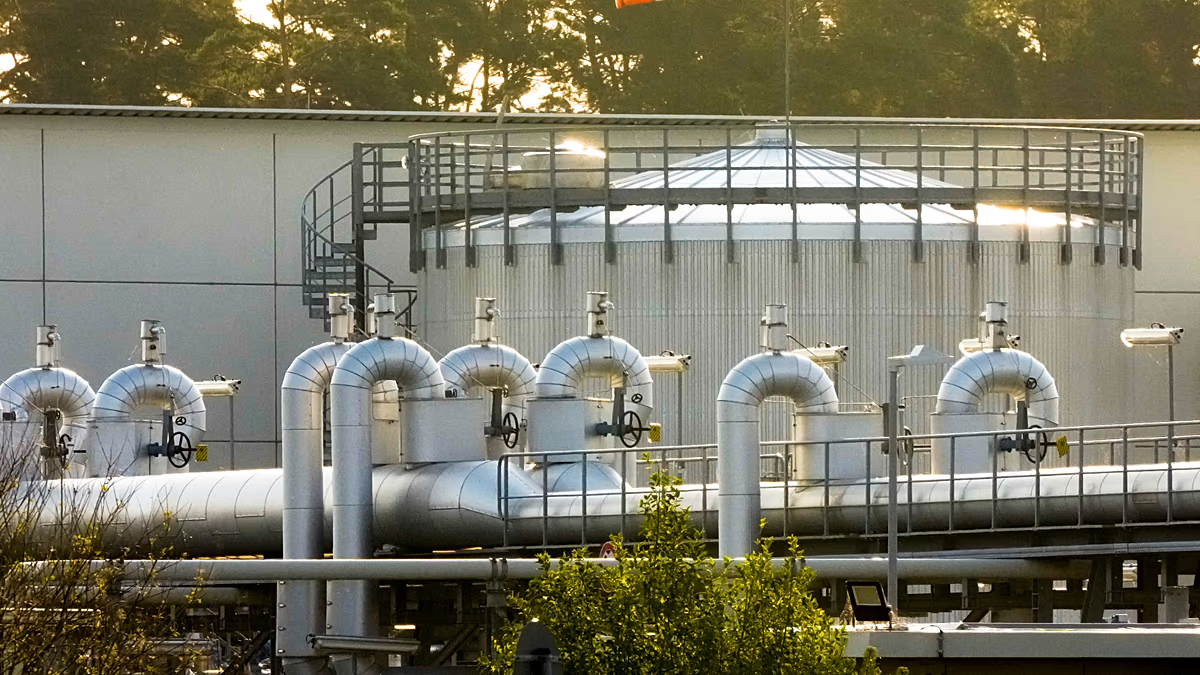

The European Commission’s recent announcement of 235 cross-border energy projects eligible for EU climate funding is facing criticism from experts and civil society groups who fear a significant portion may prolong reliance on fossil fuels. The projects, totaling over €80 billion in investment, include extensive hydrogen infrastructure development. Critics argue that many plans prioritize gas transmission networks rebranded as “hydrogen-ready”, potentially undermining the EU’s ambitious decarbonization goals and diverting funds from truly sustainable energy solutions.
The Commission identified these projects as Projects of Common Interest (PCI) and Projects of Mutual Interest (PMI), granting them privileged access to EU public financing and streamlined permitting processes. While intended to bolster the EU’s energy infrastructure, the composition of the list has raised serious concerns regarding alignment with climate objectives.
EU Hydrogen Infrastructure Faces Scrutiny
At least 100 of the approved projects focus on hydrogen infrastructure. However, a disproportionate number – over 90%, according to critics – have been submitted by operators of existing gas transmission networks. This raises the specter of “greenwashing,” where fossil fuel infrastructure is presented as contributing to the energy transition without fundamentally altering its reliance on hydrocarbons.
Civil society organizations, including Food & Water Action Europe and the CEE Bankwatch Network, have issued a joint statement expressing their alarm. They contend that without a readily available supply of renewable hydrogen, these pipelines are likely to transport hydrogen produced from fossil fuels for years to come, all while receiving public funding earmarked for a clean energy transition.
Concerns About Cost and Credibility
Gligor Radečić, campaign leader at CEE Bankwatch Network, questioned the transparency and objectivity of the project selection process. He highlighted the significant role played by ENTSOG, the European Network of Transmission System Operators for Gas, in the assessment, creating what he described as an inherent conflict of interest given ENTSOG’s members stand to profit directly from the projects.
Additionally, experts warn that repurposing existing natural gas pipelines for hydrogen transport is a highly expensive and potentially inefficient undertaking. George Verberg, former CEO of Gasunie, noted that the economics of many of these projects “simply don’t stack up,” and estimates provided by gas utilities regarding retrofitting costs are overly optimistic.
A recent report by the Agency for the Cooperation of Energy Regulators (ACER) further supports these concerns. The report indicates that current hydrogen network plans are often based on “aspirations rather than concrete market needs,” increasing the risk of over-investment in unused infrastructure that ultimately burdens taxpayers. ACER’s website provides access to their full report findings.
Paul Martin, co-founder of the Hydrogen Science Coalition, emphasizes the slow pace of renewable hydrogen market development. He suggests it’s unrealistic to expect these pipelines to carry primarily green hydrogen in the near future, with most likely transporting hydrogen derived from fossil fuels instead.
EU’s Hydrogen Targets and Funding Mechanisms
The EU has set ambitious goals for hydrogen production and consumption, aiming for 10 million tonnes of production and 10 million tonnes of imports by 2030. To achieve this, substantial investments in electrolyser technology are required, with a target of 40GW of renewable hydrogen electrolysers by 2030. Electrolysers use electricity to split water into hydrogen and oxygen, and when powered by renewable sources, produce so-called “green hydrogen.”
The projects designated as PCIs and PMIs are designed to unlock these investments. Since the program’s inception, the EU has disbursed a total of €4.7 billion to support 107 such projects. However, the allocation of these funds is now under scrutiny given the potential for supporting infrastructure that contradicts the EU’s overall decarbonization strategy.
Teresa Ribera, Executive Vice-President for Clean, Just and Competitive Transition, defended the projects, calling them “the lifeline” of the EU’s energy union and emphasizing their role in creating a unified, sustainable, and secure energy system.
European lawmakers and EU governments now have two months to review and approve the final list of projects. The decisions made in the coming months will have significant implications for the future of energy in Europe and the bloc’s ability to meet its climate commitments. Observers will be watching closely to see whether the focus shifts towards genuinely renewable hydrogen infrastructure or if existing fossil fuel interests continue to dominate the landscape. The debate highlights the need for careful consideration of hydrogen’s role in the energy transition, as outlined by the International Energy Agency.