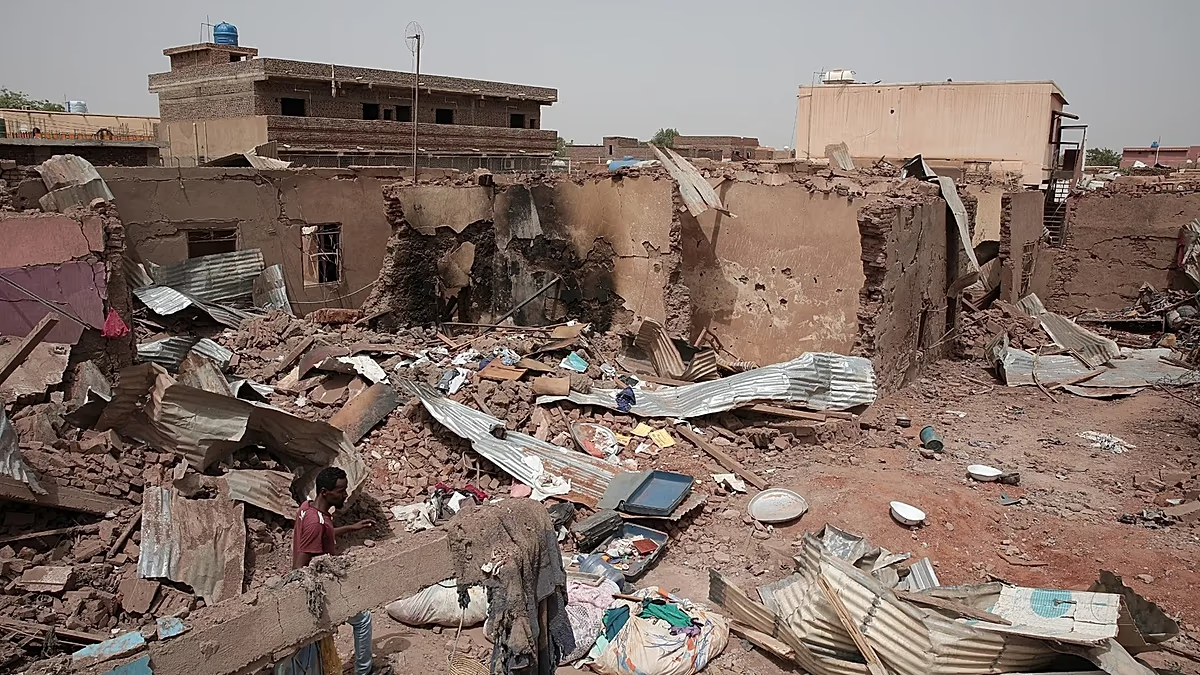

The European Parliament recently approved a resolution condemning the ongoing civil war in Sudan, but notably omitted any direct accusations against the United Arab Emirates (UAE) despite reports alleging its involvement in fueling the conflict. This decision followed intensive lobbying efforts by Emirati officials, raising questions about the influence of foreign powers on European policy regarding the devastating crisis. The resolution aims to address the urgent humanitarian situation and push for a peaceful resolution, but its lack of specific condemnation has sparked controversy.
The conflict, which erupted in April 2023 between the Sudanese Armed Forces (SAF) and the Rapid Support Forces (RSF), has plunged Sudan into a catastrophic humanitarian disaster, leaving over 150,000 people dead and nearly 25 million in need. International observers have expressed concerns over the external factors exacerbating the violence, resulting in increased scrutiny over arms flows in the region.
Resolution on Sudan Controversy
The approved resolution strongly condemns the grave violations of international humanitarian law and human rights perpetrated by both the RSF and SAF forces in Sudan. It specifically highlights the alarming use of sexual violence, including rape, slavery, and forced marriage, as a weapon of war. However, despite acknowledging “all forms of external interference fuelling the war,” the text refrains from naming any specific countries.
According to sources within the European Parliament, the European People’s Party (EPP) played a key role in removing any direct reference to the UAE. This followed lobbying from Emirati Minister of State Lana Nusseibeh, who engaged in meetings with MEPs during a visit to Strasbourg. The lobbying effort reportedly aimed to present the UAE as part of the solution, rather than a contributing factor to the conflict.
Several amendments proposed by leftist political groups explicitly mentioned the UAE’s alleged role, calling for sanctions and a halt to trade negotiations. These amendments, however, were ultimately rejected, with the EPP and right-wing groups forming a united front against their inclusion. Austrian EPP MEP Lukas Mandl stated he generally opposes “naming-and-shaming” in such cases, advocating for the UAE’s continued involvement in mediation efforts.
Allegations of UAE Involvement
The decision to exclude the UAE from the resolution contrasts with previous reports detailing alleged Emirati support for various factions involved in the Sudanese civil war. A leaked UN experts report published in April 2025 claimed that sophisticated weaponry was smuggled through the UAE and Chad, violating the UN arms embargo.
Additionally, Amnesty International released a report in May 2025 alleging that Chinese weaponry, re-exported by the UAE, was utilized in Darfur, constituting another potential breach of the arms embargo. The UAE government has consistently denied these allegations, reaffirming its commitment to a peaceful resolution in Sudan.
In a statement to Euronews, a UAE official vehemently rejected claims of providing support to either warring party and condemned atrocities committed by both the SAF and RSF. The official emphasized the UAE’s participation in the Quad group – alongside the United States, Saudi Arabia, and Egypt – as the primary mediation framework for the conflict.
The resolution does acknowledge the Quad’s role in seeking a peaceful end to the hostilities. The UAE government expressed its satisfaction with the Parliament acknowledging the Quad as the legitimate negotiation format for the conflict.
Despite the omission of direct accusations, the resolution calls on EU member states to evaluate the possibility of adding the RSF to the EU’s list of terrorist organizations. This amendment, surprisingly, was approved despite opposition from the EPP.
The outcome of this vote and the surrounding lobbying efforts illustrate the complex geopolitical dynamics influencing the response to the Sudanese conflict. As the humanitarian crisis deepens, observers will be closely watching the role of external actors and whether increased international pressure can lead to a lasting peace. Future developments will likely focus on the efficacy of the Quad’s mediation and whether the EU will reassess its position regarding potential external contributors to the violence in Sudan.