


December promises a spectacular display of celestial events for observers across the United Arab Emirates. Residents can anticipate the peak of the Geminid meteor shower, a rare conjunction of Jupiter and Saturn, and a visible comet, all offering opportunities for stargazing throughout the month. These astronomical occurrences are visible to the naked eye, though telescopes and binoculars will enhance the viewing experience.
The UAE’s strategic location and generally clear December skies make it an ideal spot for observing these phenomena. The Dubai Astronomy Group and the Emirates Astronomical Society are planning outreach events to facilitate public viewing, and the Ministry of Climate Change and Environment has encouraged residents to take advantage of the clear weather. These events will occur throughout December, peaking around specific dates for each event.
Understanding December’s Celestial Showers and Planetary Alignments
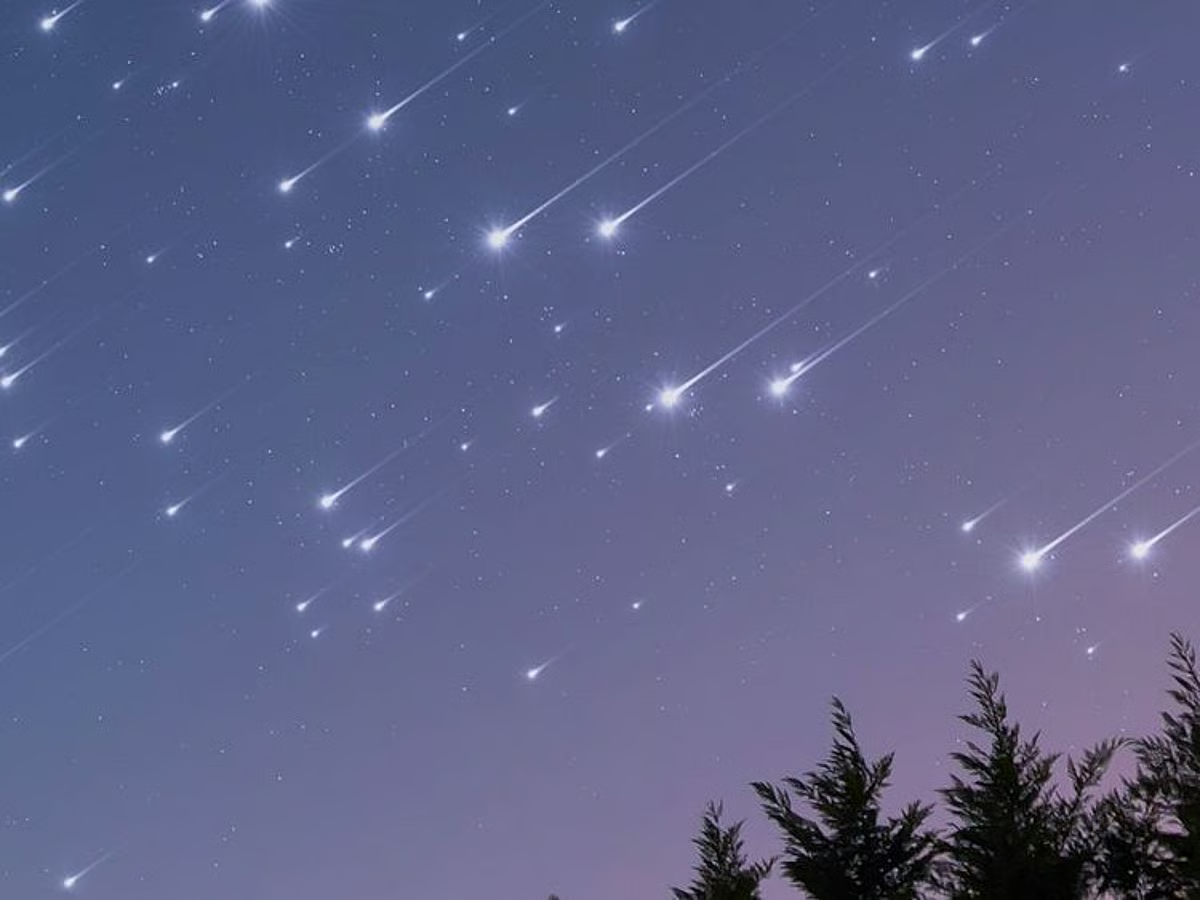
The most prominent event will be the Geminid meteor shower, peaking on the night of December 14th and early morning of December 15th. This shower is known for its high rate of meteors – potentially 120 per hour under ideal, dark-sky conditions – and the brightness of its meteors. According to the Emirates Astronomical Society, the Geminids are caused by Earth passing through debris left behind by the asteroid 3200 Phaethon.
Geminid Meteor Shower Details
The Geminids appear to radiate from the constellation Gemini, hence the name. However, observers do not need to locate Gemini to see the meteors; they will appear across the entire sky. Light pollution can significantly reduce visibility, so venturing outside of major cities is recommended for optimal viewing.
Additionally, December will feature a particularly close conjunction of Jupiter and Saturn. This event, often referred to as a “Christmas Star” due to its proximity to the winter solstice, will occur on December 21st. The two planets will appear less than a tenth of a degree apart, creating a bright, star-like point of light in the western sky after sunset. This conjunction is the closest visible alignment of the two planets since 1623.
However, the brightness of this conjunction may be affected by atmospheric conditions. Clear skies are crucial for observing the event, and any haze or cloud cover will diminish its visibility. The Dubai Astronomy Group is hosting public viewing sessions to help residents observe the conjunction with telescopes.
Meanwhile, Comet C/2023 E3 (ZTF) is expected to become visible throughout December, though its brightness remains uncertain. Initially discovered in March 2023, the comet is currently traveling towards Earth and may become visible with binoculars or a small telescope. The report indicates that the comet’s visibility will depend on its activity and how it interacts with the solar wind.
Comet Visibility and Tracking
Comet C/2023 E3 (ZTF) is currently located in the constellation Corona Borealis. Its path will shift throughout December, making it visible in different parts of the night sky. Astronomers are using online tools and star charts to track the comet’s movement and predict its brightness.
In contrast to meteor showers, which are best viewed with the naked eye, comets and planetary conjunctions often benefit from magnification. Telescopes and binoculars can reveal details that are invisible to the unaided eye, such as the comet’s coma and tail, or the cloud bands on Jupiter and Saturn. The Emirates Astronomical Society recommends using a star chart or astronomy app to locate these objects.
The UAE government has not issued any specific advisories related to these celestial events, but the Ministry of Climate Change and Environment encourages responsible stargazing practices. This includes minimizing light pollution by using red-light flashlights and avoiding excessive outdoor lighting. The ministry also advises checking weather forecasts before planning any stargazing activities.
These celestial events offer a unique opportunity for residents and visitors to connect with the wonders of the universe. The combination of the Geminid meteor shower, the Jupiter-Saturn conjunction, and the potential visibility of Comet C/2023 E3 (ZTF) makes December a particularly exciting month for astronomy enthusiasts. Observing these phenomena can also foster a greater appreciation for science and the natural world.
Furthermore, the increased public interest in astronomy prompted by these events may lead to greater investment in astronomical research and education within the UAE. The Dubai Astronomy Group and the Emirates Astronomical Society are actively working to promote astronomy education and outreach programs throughout the country. This includes workshops, lectures, and public viewing sessions.
The long-term implications of these celestial events are primarily educational and inspirational. They provide a tangible connection to the vastness of space and encourage curiosity about the universe. However, the data collected from observing comets and meteor showers can also contribute to scientific understanding of the solar system and its origins. The study of astronomical phenomena helps scientists learn more about the composition of asteroids, comets, and the interplanetary environment.
Looking ahead, astronomers are already anticipating other significant celestial events in 2024, including a total solar eclipse visible from parts of North America. The Emirates Astronomical Society is planning to organize observation trips to witness this event. The precise details of these trips, including dates and costs, will be announced in the coming months. Residents should monitor the society’s website for updates and further information.