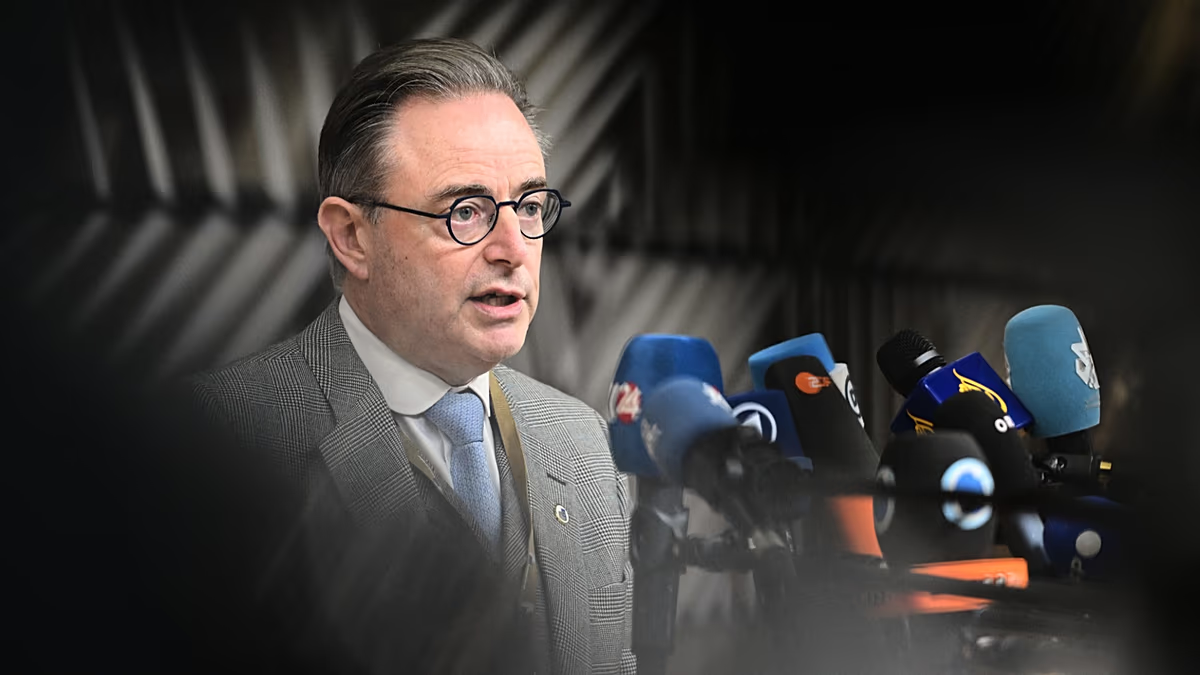

Belgian Prime Minister Bart De Wever continues to voice strong opposition to the European Union’s plan to utilize immobilized Russian assets to fund Ukraine’s reconstruction, characterizing the proposal as “fundamentally wrong.” This stance is creating a significant hurdle for the EU as it seeks a unified approach to supporting Kyiv amidst its ongoing conflict with Russia. The dispute centers around a potential €185 billion held in Euroclear, a Brussels-based central securities depository.
De Wever, in a recent letter to European Commission President Ursula von der Leyen, proposes an alternative: a joint EU borrowing of €45 billion. He argues this method would ultimately be cheaper than leveraging the Russian assets, particularly when accounting for potential legal challenges and associated risks. The Prime Minister fears Belgium, as the host nation for Euroclear, would bear the brunt of any legal retaliation from Moscow.
Concerns Over Russian Asset Seizure and Potential Legal Ramifications
The core of De Wever’s argument lies in the unprecedented nature of repurposing sovereign assets during an active war. He contends such action could set a dangerous precedent and undermine the established principles of international finance. He also warns it could jeopardize ongoing peace negotiations, despite some EU leaders believing the assets represent key leverage against Russia.
According to De Wever’s four-page letter, Belgium could be held liable for the entire loan amount, potentially reaching €140 billion, along with any arbitration costs. He stresses this is not a theoretical risk, comparing it to a plane crash – low probability, but catastrophic consequences.
Initially, De Wever held up the asset proposal in October, demanding full risk-sharing among EU member states, complete transparency regarding all Russian assets held within the bloc, and airtight legal guarantees. He made it clear Belgium would not unilaterally bear the financial burden of the controversial scheme.
The European Commission has been in discussions with Belgium to address these concerns, with von der Leyen outlining three support options for Ukraine earlier this month: bilateral contributions, common EU borrowing, and the reparations loan utilizing Russian assets. Von der Leyen has repeatedly stated that European taxpayers should not be solely responsible for Ukraine’s financial support.
Diverging Views Among EU Member States
While Belgium expresses reservations, many other EU nations, including Germany, Poland, and the Baltic states, favor the reparations loan. This approach aligns with the principle of “making Russia pay” for the damage caused by its invasion of Ukraine and would initially spare their national budgets.
German Chancellor Friedrich Merz recently suggested a decision on the reparations loan could strengthen the EU’s position in US-led peace talks. This contrasts with De Wever’s belief that the loan itself could hinder such negotiations.
A previous, highly debated plan involved using the Russian assets for the commercial benefit of both Russia and the United States, but this provision was reportedly removed following discussions between Washington and Kyiv. The EU has maintained that any use of Russian assets under its jurisdiction requires its full involvement.
Meanwhile, Russian President Vladimir Putin has warned that any attempt to seize the funds would be considered theft and would trigger retaliatory measures from Russia. This adds another layer of complexity to the EU’s deliberations.
The 27 EU leaders are scheduled to convene in Brussels on December 18-19 to reach a final decision on the matter. This decision is crucial for approving Ukraine’s new program with the International Monetary Fund. De Wever hasn’t entirely dismissed the reparations loan, but he insists on “legally binding, unconditional, irrevocable, on-demand, joint and several guarantees” covering the full €185 billion and potential legal costs.
Additionally, De Wever cautions that the loan could be perceived as illegal confiscation by other nations and investors, potentially discouraging them from holding assets within the EU. This could have broader implications for the European financial system. The IMF is closely watching the situation as it develops.
The coming weeks will be critical as the EU attempts to reconcile differing national interests and navigate the complex legal and financial challenges surrounding the use of Russian assets. Stay informed about this evolving situation and its potential impact on the future of Ukraine and the European financial landscape.