






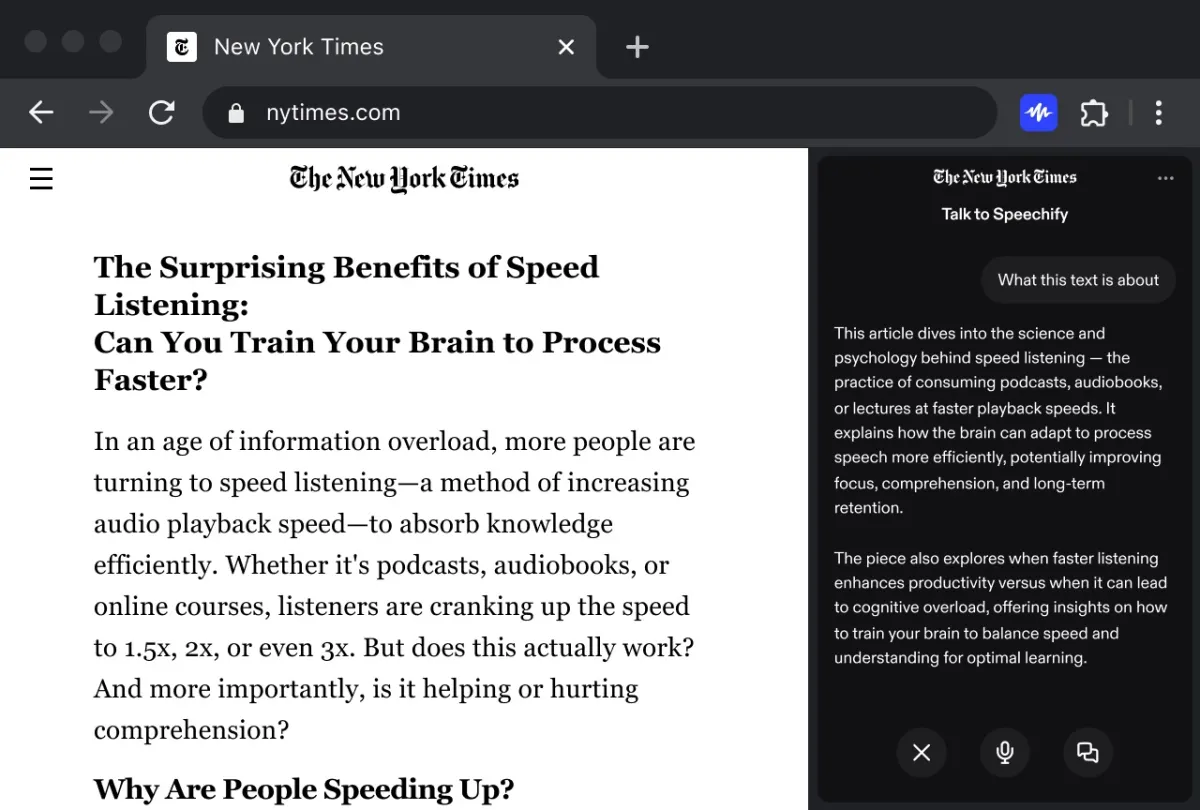

Speechify, a company known for its text-to-speech technology, is expanding its offerings with new voice typing and voice assistant features integrated into its Chrome extension. The move comes as speech recognition technology rapidly improves and gains wider adoption across various platforms. These updates aim to provide users with more hands-free interaction with web content and enhance productivity through dictation and AI-powered assistance.
The initial release focuses on English language support for both voice typing and the conversational assistant. Speechify’s new features reflect a broader trend of incorporating voice control into everyday computing, driven by advancements in artificial intelligence and machine learning. The company plans a phased rollout, extending capabilities to its desktop and mobile applications.
Speechify Launches Voice-Enabled Tools
The core of the update is a voice typing tool that allows users to dictate text directly into supported applications. Similar to other dictation software, Speechify’s system aims to correct errors and filter out common filler words such as “um” and “ah,” streamlining the writing process. According to the company, this functionality will become more accurate over time as the models learn from user input.
Currently, implementation is smoother in applications like Gmail and Google Docs. However, early user testing, including a report by TechCrunch, reveals some inconsistencies when utilized with content management systems such as WordPress, highlighting ongoing optimization efforts. The company notes it’s prioritizing enhancements for popular websites to ensure a consistent user experience.
Accuracy and Competition
Initial assessments suggest the accuracy of Speechify’s voice typing, as measured by word error rate, is slightly higher than established competitors like Wispr Flow, Willow, and Monologue. Speechify addresses this by explaining their models are designed for continuous learning, suggesting the gap will shrink with increased usage.
The market for dictation software is becoming increasingly competitive, with numerous players vying for user attention. These tools cater to a variety of needs, from assisting individuals with disabilities to boosting productivity for fast typists.
A Voice Assistant Built for the Browser
Alongside voice typing, Speechify has introduced a conversational voice assistant accessible through the browser’s sidebar. This assistant is designed to analyze web pages and answer user questions about the content. Users can ask the assistant to summarize key ideas or explain complex topics in simpler terms.
Speechify differentiates its assistant from those offered by tech giants like OpenAI (ChatGPT) and Google (Gemini) by asserting that voice interaction is central to its design. Rohan Pavuluri, Speechify’s chief business officer, stated in an email to TechCrunch that voice is intended to be the “primary, default setting” for Speechify users, unlike the more chat-focused approach of its larger rivals.
However, this new assistant currently lacks compatibility with browsers already featuring integrated sidebar assistants, such as those from OpenAI (Atlas) and Perplexity (Comet). Speechify appears to be concentrating on the extensive Chrome user base for initial support.
Future Development and Agent Technology
Looking ahead, Speechify intends to expand beyond simple dictation and question answering. The company is exploring the development of “agents” capable of autonomously completing tasks on the user’s behalf. As an example, they cite the possibility of using these agents to schedule appointments or navigate customer service phone menus.
This ambition places Speechify alongside companies like Truecaller and Cloacked, which are also actively developing AI-powered assistants designed to handle routine tasks. The path forward involves addressing challenges related to security, privacy, and the reliability of AI-driven automation.
The complete rollout of these features to all Speechify platforms—desktop and mobile—is expected to occur gradually over the coming months. The company has not provided a definitive timeline for the introduction of agent technology or broad browser support. The ongoing success of Speechify’s voice initiatives will depend on improving accuracy, expanding compatibility and continuing to innovate within the rapidly evolving field of voice typing and conversational AI.