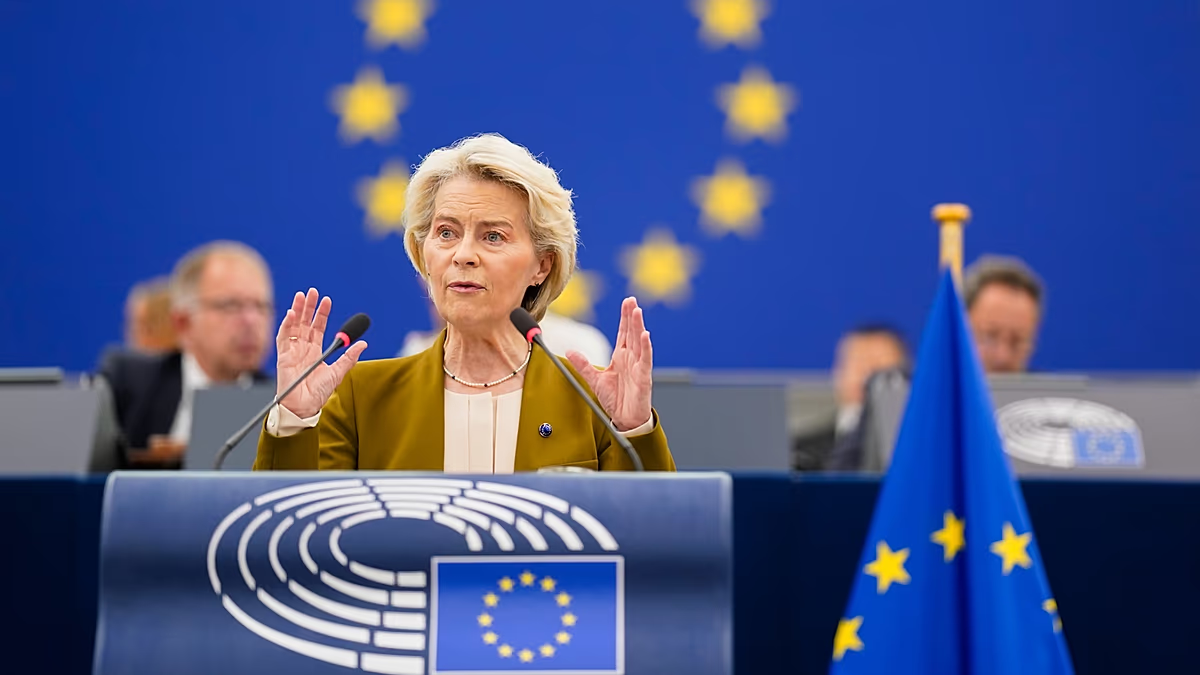

European Commission President Ursula von der Leyen warned on Wednesday that Europe must maintain strong pressure on Russia, asserting the country’s continued ambition to redraw borders and reassert its influence in Eastern Europe. This comes as US-led peace talks raise the possibility of economic concessions to Moscow, despite its ongoing assault on Ukraine. The situation highlights the delicate balance between seeking a resolution to the conflict and ensuring accountability for Russian aggression, a key concern for European Parliament members.
Von der Leyen stated that Russia consistently believes it can outlast Ukraine, Europe, and its allies, and that escalations in violence often coincide with progress in peace negotiations. She pointed to recent Russian strikes targeting Ukraine’s civilian population as evidence of this pattern, suggesting a broader strategic goal beyond simply controlling Ukrainian territory. The comments underscore the growing anxiety within Europe that any peace deal must not come at the expense of Ukrainian sovereignty or European security.
The Future of Ukraine and European Security
The Kremlin has signaled its rejection of a revised peace plan developed during talks between American and Ukrainian officials in Geneva. The initial 28-point draft reportedly contained provisions heavily favoring Moscow, prompting concern among European leaders who felt excluded from the initial discussions. These proposals touched upon issues under European jurisdiction, including economic sanctions and the handling of immobilized Russian assets.
In response, EU leaders held emergency meetings, including an informal summit and a virtual gathering of the “Coalition of the Willing,” to coordinate a unified European stance and support Kyiv in renegotiating the terms. Von der Leyen emphasized the principle of “Nothing about Ukraine without Ukraine, nothing about Europe without Europe, nothing about NATO without NATO,” signaling a commitment to ensuring European interests are central to any resolution.
Contentious Points in Negotiations
Key sticking points in the negotiations include limiting the size of the Ukrainian armed forces and providing robust security guarantees to prevent future invasions. Western allies are considering deploying a multinational force to Ukraine after the war to bolster deterrence, a proposal Moscow has rejected. Von der Leyen argued against limiting Ukraine’s military capabilities, emphasizing the need for a strong defense to deter further aggression.
The Commission President also warned against legitimizing the forceful alteration of borders, stating that such action would set a dangerous precedent and potentially incite further conflicts. She drew parallels to historical power dynamics, suggesting Russia still views the continent through the lens of “spheres of influence,” a concept Europe is determined to resist.
Meanwhile, the financial burden of supporting Ukraine remains a significant challenge. Estimates for Ukraine’s financial and military needs for 2026 and 2027 reach €135 billion. The European Commission has proposed three options for covering this gap: bilateral contributions from member states, common EU borrowing, and a “reparations loan” utilizing the approximately €210 billion in immobilized Russian Central Bank assets.
While many EU capitals favor the reparations loan to avoid straining national budgets, Belgium, which holds a substantial portion of the assets, has expressed reservations due to fears of Russian retaliation. Von der Leyen affirmed the Commission’s willingness to draft legal text to address Belgium’s concerns, but reiterated that European taxpayers should not bear the full cost of Ukraine’s reconstruction. She stressed that any solution must adhere to European and international law.
The original 28-point plan reportedly included a model allowing Washington and Moscow to profit from the immobilized assets, a provision believed to have been removed following the Geneva talks. Further negotiations are ongoing to determine the fate of these funds.
Von der Leyen concluded by reaffirming the need to maintain pressure on Russia through continued sanctions, noting that the EU has already implemented 19 packages of sanctions since February 2022, and the US recently sanctioned Russia’s Rosneft and Lukoil. The situation remains complex and volatile, but she expressed optimism that progress can be made towards a just and lasting peace. The coming weeks will be crucial as EU leaders prepare to meet on December 18th to decide on a financial plan for Ukraine, and as diplomatic efforts continue to navigate the path towards a resolution.