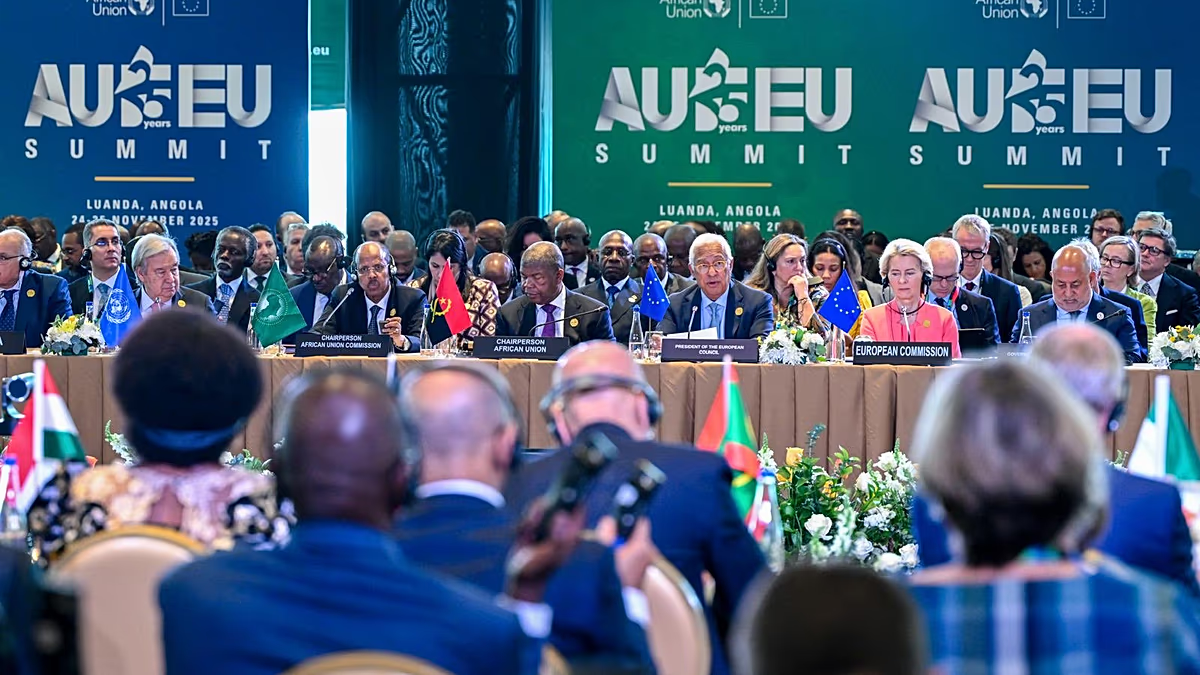

The European Union and African Union have reaffirmed their commitment to bolstering green investments and developing regional infrastructure, following a two-day summit in Luanda, Angola. The renewed partnership focuses on supporting Africa’s energy transition, securing critical raw materials, and fostering sustainable development across the continent. This collaboration comes as the EU strives to meet its ambitious climate goals and diversify its supply chains.
The summit, marking 20 years since the first EU-AU gathering, followed closely on the heels of the G20 meeting in Johannesburg, where the EU announced a trade deal with South Africa centered on clean projects and investments. These developments signal a growing emphasis on Africa as a key partner in the global shift towards a more sustainable future.
EU-Africa Partnership Drives Green Investment
The EU is committed to achieving net neutrality by 2050, a target requiring substantial investment in renewable energy sources like solar and wind power, as well as battery technology for electric vehicles. While prioritizing domestic production, the EU recognizes Africa’s significant potential in these areas, particularly its abundant sunlight and rich deposits of essential minerals like lithium and cobalt.
According to the joint EU-AU statement, both blocs will collaborate to advance a just and clean energy transition, focusing on rural electrification, sustainable industrialization, and access to clean cooking solutions. Efforts will also be directed towards accelerating the deployment of sustainable aviation fuels and improving transport systems.
Infrastructure Development and Critical Minerals
A key component of the partnership involves infrastructure development. The European Investment Bank (EIB), the EU’s lending arm, recently announced a €350 million loan to Transnet, South Africa’s state-owned transport and logistics company, to modernize port infrastructure and support the development of green hydrogen production. This investment builds on the EU’s Global Gateway program, which has already unlocked nearly €2 billion in funding for the Lobito corridor project, connecting Angola, the Democratic Republic of Congo, and Zambia.
Additionally, the EU signed a trade deal with South Africa focused on clean energy, critical raw materials, electricity transmission, and infrastructure grids. Commission Executive Vice President for Industrial Strategy Stéphane Séjourné emphasized the importance of cooperation with trusted partners like South Africa to secure the EU’s supply chain of critical raw materials. European Commission President Ursula von der Leyen added that the deal would contribute to South Africa’s economic development.
The EU has pledged nearly €12 billion in clean energy investments in South Africa under the Global Gateway program, with funds allocated to green hydrogen production, critical raw materials, re-skilling initiatives, and climate adaptation measures. Africa has laid out a strategy to produce 500,000 tonnes of green hydrogen annually by 2030, scaling up to 7 million tonnes by 2050, aligning with the EU’s goal of importing 10 million tonnes of green hydrogen by 2030.
However, some organizations, like Corporate Europe Observatory, raise concerns that the majority of funding comes in the form of loans and guarantees to European corporations, potentially increasing debt burdens for African nations. They argue that the EU must avoid “energy colonialism” and ensure a truly just transition.
Mahamoud Ali Youssouf, chairperson of the African Union, highlighted the importance of action, stating that the strength of the renewed partnership will be measured by the progress made for Africa’s youth.
Looking ahead, the success of this EU-Africa partnership will depend on translating commitments into concrete action and addressing concerns about equitable financing and debt sustainability. Observers will be watching closely to see how these investments translate into tangible benefits for African economies and contribute to a truly sustainable and inclusive energy transition. The European Investment Bank will likely play a central role in financing future projects.