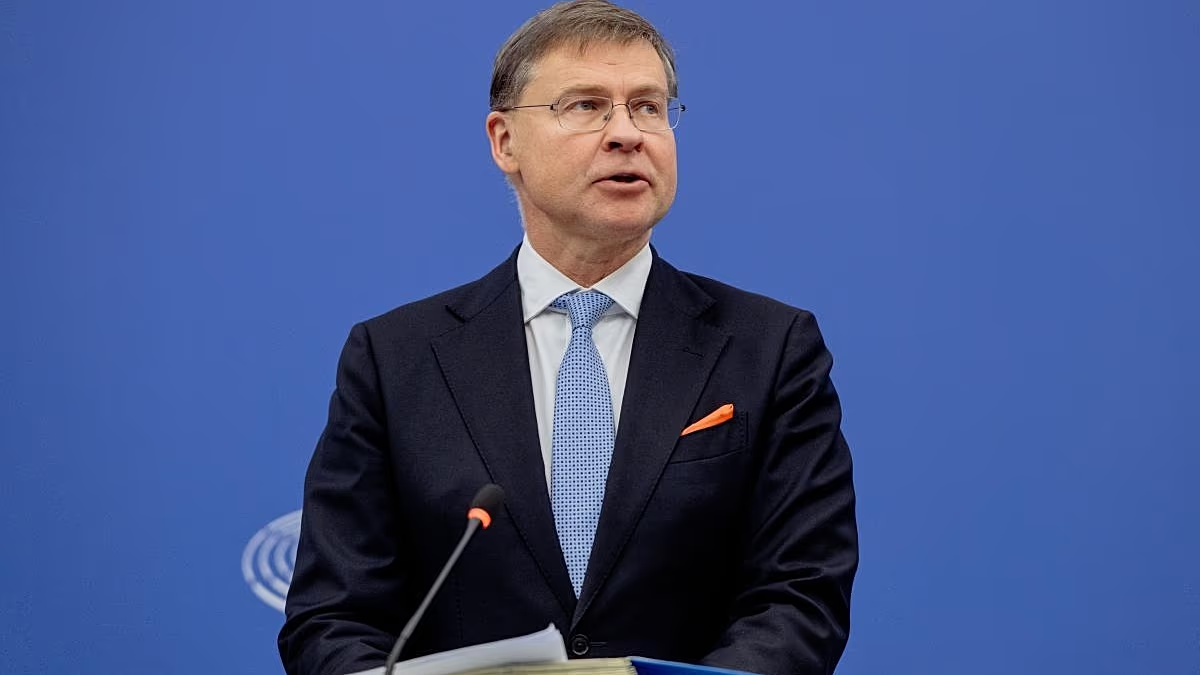

The European Commission issued a warning today, November 25, 2025, regarding potential breaches of EU budget rules by several member states, including Spain, Hungary, Malta, and the Netherlands. Concerns center around public spending drifting from agreed fiscal paths, raising the possibility of financial penalties. This comes as governments navigate increased spending on defense and industrial investments alongside ongoing economic challenges.
The Commission’s assessment focuses on adherence to the established criteria of budget deficits remaining below 3% of Gross Domestic Product (GDP) and public debt under 60% of GDP. Crucially, the evaluation extends beyond next year’s budgets to examine the credibility of longer-term deficit reduction plans. According to European Commissioner for Economy Valdis Dombrovskis, member states at risk are being urged to implement necessary corrective measures.
Risks to EU Budget Rule Compliance
Several factors are contributing to the increased difficulty in maintaining fiscal discipline across the EU. Increased fiscal flexibility has been granted to bolster defense capabilities and stimulate industrial investment, largely in response to external pressures. Additionally, escalating trade tensions with the United States are creating economic headwinds for European nations.
Despite a recent increase in US tariffs to 15% on European goods, the European Commission’s latest economic forecast, published on November 18th, still projects a 1.4% growth for the EU economy in 2025. Poland and Spain are expected to be major drivers of this growth, with forecast rates of 3.2% and 2.9% respectively. However, the growth prospects for the EU’s largest economies – Germany, France, and Italy – remain comparatively subdued.
The Commission cautions that the medium-term growth outlook remains uncertain, even if the economic impact of the higher tariffs proves less severe than initially anticipated. Countries like Croatia, Lithuania, and Slovenia have also been asked to demonstrate further commitment to their agreed fiscal targets for 2026.
Spain, Bulgaria, and Hungary are specifically flagged as being at risk of exceeding agreed norms for primary net expenditure. For now, the Commission is requesting these nations to reduce spending in 2026. Failure to comply could lead to the consideration of financial penalties during the next budget review in the spring.
Finland Faces Excessive Deficit Procedure
In a separate but related development, the European Commission has decided to reprimand Finland for non-compliance with EU fiscal rules. This decision follows a warning that Finland’s deficit is projected to reach 4.5% of its annual GDP this year. The Commission will recommend launching an “excessive deficit procedure” (EDP) against Finland, pending approval from EU finance ministers.
Currently, nine other EU countries, including France, Italy, and Poland, are already under an EDP. Dombrovskis emphasized that Finland’s deficit isn’t solely attributable to increased defense spending. He also acknowledged “exceptional circumstances,” including the impact of Russia’s war on investor and consumer confidence, and the economic consequences of closing Finland’s land border with Russia, which significantly reduced tourism.
Finnish finance minister Riikka Purra stated that the country will adhere to the adjustment pace recommended by the Council. She acknowledged that significant work will be required across multiple parliamentary terms to restore public finances to a sustainable level.
Germany narrowly avoided a similar reprimand by activating a “national escape clause” to accommodate increased defense spending in 2025. This highlights the delicate balance between national security priorities and maintaining economic stability within the EU framework.
The situation underscores the challenges facing European governments as they attempt to navigate a complex economic landscape. Balancing increased defense spending, industrial policy goals, and adherence to EU budget discipline will be a key focus in the coming months. Investors and policymakers will be closely watching the responses of the flagged member states and the Commission’s subsequent actions to ensure the long-term health of the Eurozone. Stay informed about further developments regarding these crucial economic indicators and policy decisions.