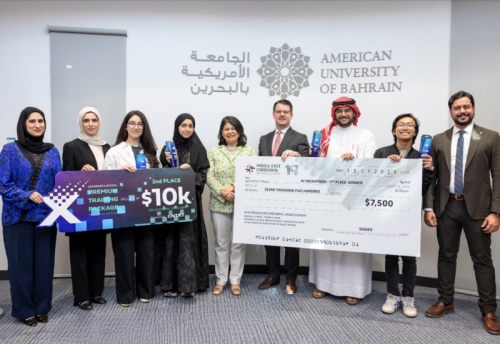

The American University of Bahrain (AUB) is celebrating a significant achievement by its students in the field of artificial intelligence, demonstrating the growing strength of STEM education in the Kingdom. A team from AUB recently secured second place at the inaugural Artificial Intelligence Hackathon held at the 19th Middle East Corrosion and Asset Safety Conference and Exhibition in Dhahran, Saudi Arabia. This victory highlights AUB’s commitment to fostering innovation and preparing students for the challenges of a rapidly evolving technological landscape.
AUB Students Excel at Regional AI Hackathon
The prestigious event, which attracted over 1,500 students from across the Middle East, served as a crucial platform for showcasing cutting-edge solutions in corrosion prevention and materials science. The AUB team, comprised of Jana Abu Sarhan, Lawrence Mascarenas, Abdulaziz Ajlan, and Malak Al Salam, distinguished themselves by tackling the complex challenge of Material Failure Analysis.
Their innovative approach involved developing an AI model designed to pinpoint the root causes of material failures in industrial settings. This isn’t just an academic exercise; it’s a practical solution with the potential to significantly improve safety and efficiency across various engineering sectors. The team’s project directly addresses a critical need for proactive maintenance and risk mitigation in industries reliant on robust materials.
Addressing a Real-World Problem with AI
The core function of the AUB team’s AI model is to reduce the reliance on manual inspection processes. Manual inspections, while necessary, are often time-consuming, prone to human error, and can be costly. By leveraging the power of machine learning, the model can analyze data, identify patterns, and predict potential failures before they occur.
This predictive capability allows for preventative maintenance, minimizing downtime and reducing the risk of catastrophic incidents. Furthermore, the model doesn’t just identify problems; it also recommends potential solutions, offering a comprehensive approach to asset safety. This focus on preventative measures is a key aspect of modern asset integrity management.
Recognition and Support for Innovation
The team’s impressive performance earned them a substantial reward: a $7,500 cash prize (approximately BD 2,824.34). However, the benefits extend far beyond the monetary value. They also received $10,000 (BD 3,765.79) in project incubation support, educational grants, and valuable research opportunities.
This support is designed to help the students transform their hackathon project into a scalable and commercially viable solution. The incubation phase will provide them with the resources and mentorship needed to refine their model, develop a business plan, and potentially launch a startup. This is a fantastic example of how academic institutions can support student entrepreneurship.
AUB Leadership Praises Student Achievement
Dr. Wafa Al-Mansouri, acting president of AUB, expressed her congratulations to the team, emphasizing the significance of their accomplishment. “This victory showcases our students’ exceptional talent and our university’s commitment to innovation and excellence,” she stated. “It reflects our mission to nurture national cadres capable of leading the future.”
Dr. Al-Mansouri’s statement underscores AUB’s dedication to providing a high-quality education that equips students with the skills and knowledge needed to succeed in a competitive global market. The university’s investment in STEM programs and its support for student research are clearly paying dividends.
Looking Ahead: Enhancing Industrial Safety
The winning students themselves expressed their gratitude to AUB for its unwavering support throughout the hackathon. They described the experience as transformative, allowing them to apply their theoretical knowledge to a real-world problem. They are now eager to further develop their artificial intelligence model, with the goal of enhancing industrial safety not only in Bahrain but also across the wider region.
Additionally, the team is exploring potential collaborations with local industries to pilot their solution and gather valuable feedback. This collaborative approach will be crucial for ensuring that the model is tailored to the specific needs of Bahrain’s industrial sector. The future looks bright for these talented students and their innovative project, promising a safer and more efficient future for engineering and asset management.
This achievement by AUB students is a testament to the power of AI and its potential to revolutionize industries. It also highlights the importance of investing in STEM education and fostering a culture of innovation within academic institutions.