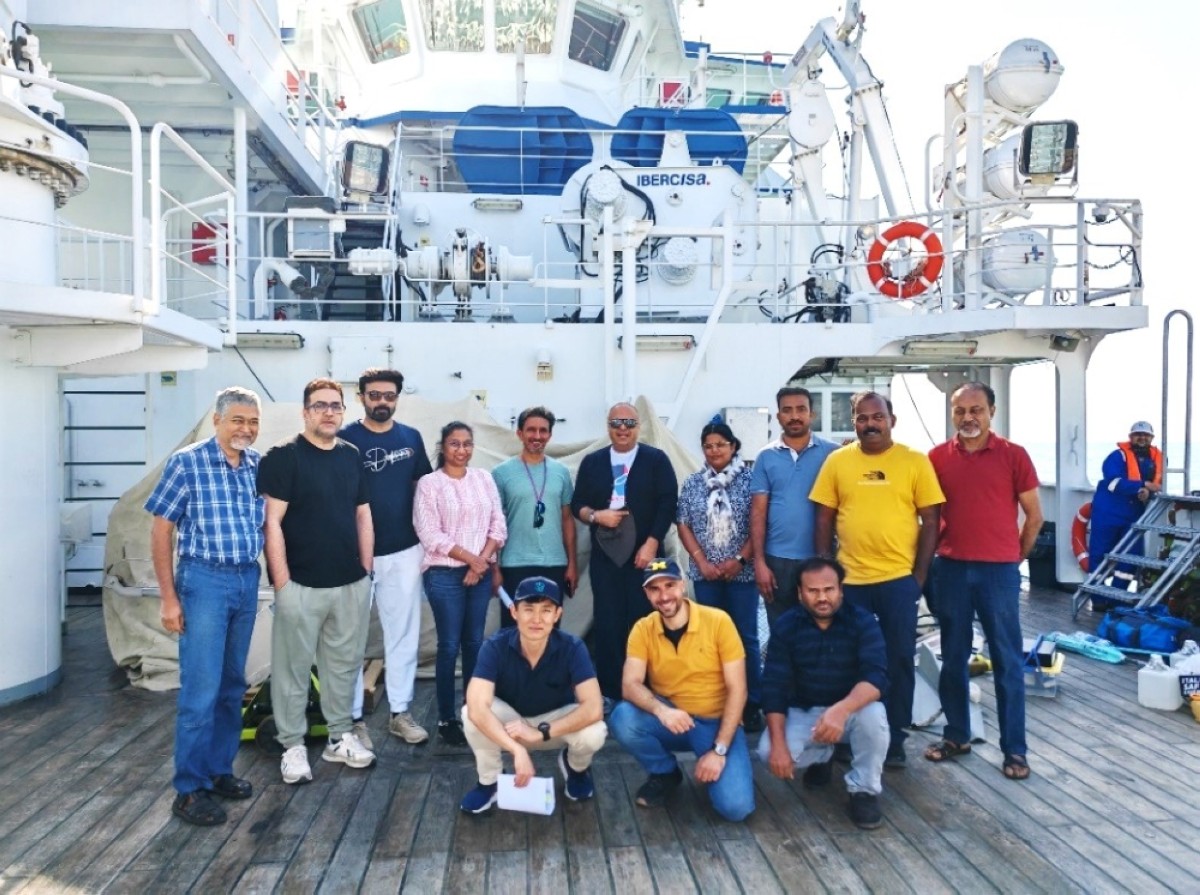

Kuwait has taken a significant stride in marine research with the successful completion of its first comprehensive oceanographic expedition. The mission, conducted last October aboard the state-of-the-art research vessel “Al-Mustakshif” (Explorer), marks a pivotal moment in understanding and protecting Kuwait’s valuable marine environment. This groundbreaking initiative, spearheaded by the Kuwait Institute for Scientific Research (KISR), promises to establish a crucial baseline for future studies and contribute to the nation’s sustainability goals.
Pioneering Marine Research: The ALM001 Expedition
Dr. Turki Al-Saeed, Director of KISR’s Coastal and Marine Resources Management Program, hailed the ALM001 expedition as a “historic achievement” for Kuwait. The expedition wasn’t a solo effort; it was a collaborative undertaking, fueled by four scientific projects supported by the Kuwait Foundation for the Advancement of Sciences (KFAS). This partnership underscores Kuwait’s commitment to investing in scientific advancement and environmental stewardship.
The primary goal of the expedition was to build a comprehensive reference database detailing the physical, chemical, and biological characteristics of Kuwait’s marine ecosystems. This database will serve as an invaluable resource for scientists, policymakers, and conservationists for years to come.
Advancing National Capabilities
Dr. Al-Saeed emphasized that the expedition demonstrated both the operational readiness of “Al-Mustakshif” and the enhanced national capabilities in marine research. The vessel, equipped with advanced monitoring systems and specialized laboratories, allowed for precise sampling across both coastal and offshore locations, with continuous 24-hour monitoring.
Experts and engineers meticulously calibrated these systems, ensuring the accuracy and reliability of the collected data. The integration of hydrography, biochemistry, and marine ecology allowed scientists to gather extensive information on surface and benthic ecosystems, analyzing over 30 different variables.
The “Al-Mustakshif”: A State-of-the-Art Research Vessel
The research vessel “Al-Mustakshif” itself is a testament to Kuwait’s dedication to scientific exploration. Measuring approximately 56 meters in length, it ranks among the most advanced scientific vessels in the Middle East. The vessel boasts seven specialized laboratories dedicated to chemistry, biology, acoustics, and fisheries.
This allows for on-board analysis and minimizes the need to transport sensitive samples long distances. Furthermore, “Al-Mustakshif” can sustain continuous voyages for up to 18 days, accommodating a crew of 15 and 14 scientific researchers. Its advanced technology, including topographic seabed surveying, sonar systems, and dynamic stabilization, ensures precise and comprehensive studies of the marine environment.
Data Collection and Analysis
The expedition yielded a wealth of data, covering a wide range of parameters. Scientists were able to analyze physical characteristics like water temperature and salinity, chemical components, and the distribution and abundance of marine organisms. This holistic approach is crucial for understanding the complex interactions within the marine ecosystem.
The data collected will be instrumental in supporting crucial studies, including those focused on climate change and its impact on coastal regions. It will also contribute to the development of sophisticated coastal ecosystem models and strengthen national monitoring programs.
Supporting Kuwait’s Environmental Vision
The insights gained from the ALM001 expedition directly support Kuwait Vision 2035, particularly its goals related to environmental sustainability and the protection of marine life. By establishing a robust understanding of the marine environment, Kuwait can make informed decisions regarding resource management, conservation efforts, and coastal development.
Dr. Al-Saeed highlighted that this expedition is not a one-time event, but rather the beginning of a series of regular seasonal voyages. These ongoing studies will strengthen Kuwait’s position as a leader in regional and international oceanographic research. Oceanography, at its core, is the multidisciplinary study of the seas and oceans, encompassing their physical, chemical, biological, and geological characteristics and their ecological impacts.
In conclusion, the successful completion of the ALM001 expedition represents a landmark achievement for Kuwait. The data collected, the capabilities demonstrated by “Al-Mustakshif,” and the collaborative spirit of the project all point towards a brighter future for marine research and environmental protection in the region. This initiative not only enhances our understanding of Kuwait’s marine environment but also positions the nation as a key player in addressing global challenges related to ocean health and climate change. To learn more about KISR’s ongoing research and initiatives, visit their official website.