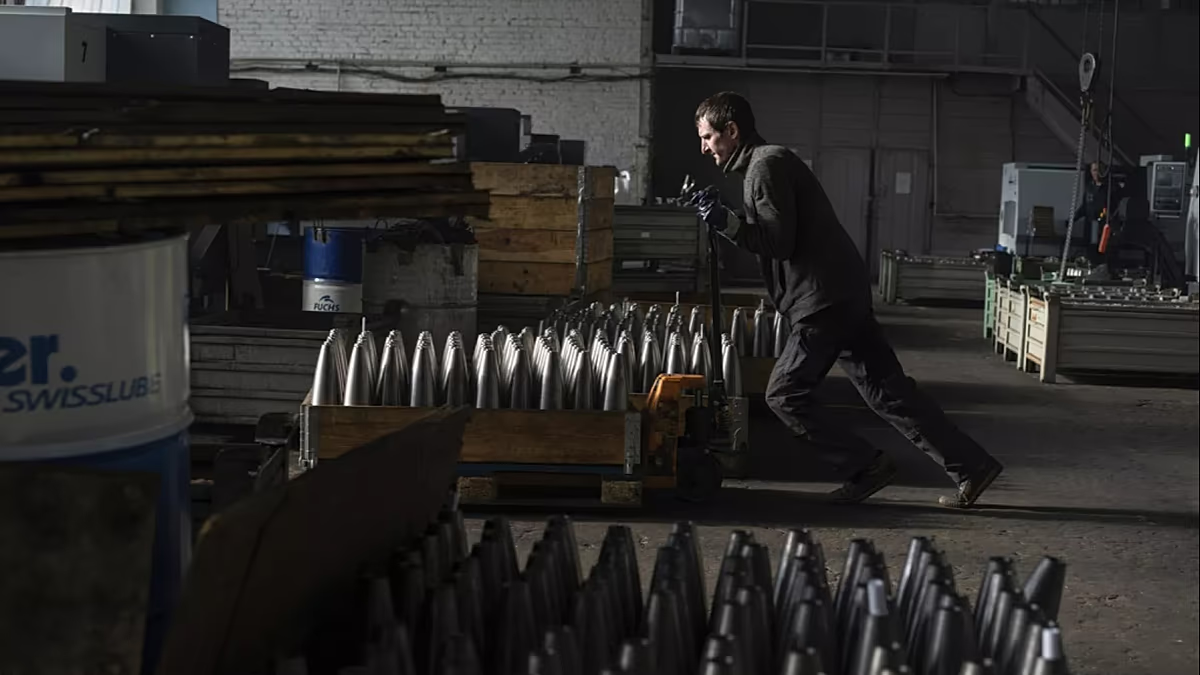

Italian arms sales to Ukraine have surpassed €643 million since Russia’s full-scale invasion began in February 2022, according to a recent report to parliament. The Annual Report on Authorised Transit, Import and Export of Armaments details the increasing financial commitment made by Italian companies to support Ukraine’s defense, though transparency remains limited regarding specific manufacturers and the full extent of military aid provided.
The report reveals a significant increase in export authorizations to Ukraine between 2022 and 2023, jumping from €3.8 million (four authorizations) to over €417 million (15 authorizations). However, 2024 saw a decrease to just over €222 million across seven authorizations. While the report confirms the authorizations, it does not disclose which Italian companies were involved, nor does it confirm whether all authorized sales materialized.
What Weapons Have Been Sold to Ukraine?
According to the report, 2023 exports encompassed a broad range of military equipment. This included weapon systems larger than 12.7mm, ammunition, fire direction systems, land vehicles, materials related to toxic, chemical, and biological warfare, explosives, military fuels, and electronic components. In 2024, exports were more focused, limited to the first four categories: large-caliber weapon systems, ammunition, fire direction equipment, and land vehicles.
However, the figures represent only direct sales from Italian companies to Ukraine. They do not include military assistance provided through EU aid packages, such as the upcoming twelfth package scheduled for December. Francesco Vignarca, a spokesperson for the Italian Network for Peace and Disarmament, points to a lack of transparency surrounding Italy’s contributions to these broader aid efforts.
Lack of Transparency
“On this part, which is not covered by the report law 185/90, there has been little transparency on the part of Italy,” Vignarca stated. Unlike other European nations, Italy has chosen not to disclose details regarding its direct military contributions. Information on battlefield use comes primarily from observation of the conflict itself.
Eleonora Tafuro Ambrosetti of the Ispi Institute for International Policy Studies notes the difficulties in generating precise figures due to the secrecy surrounding these transactions. “It is difficult to estimate quantities and figures because many of these sales are secret,” she said, adding that Italy is believed to have supplied Samp-T air defense batteries to Ukraine between 2023 and 2024.
The Italian Defence Ministry, in comments to Euronews, confirmed that details of supplies provided through aid packages are deliberately withheld “not to provide a technical advantage to Russia regarding what is on the battlefield.” Information is restricted even within the government, with only the Parliamentary Committee for the Security of the Republic (Copasir) fully briefed, under a requirement of confidentiality.
Replenishing military stocks depleted by aid to Ukraine is a complex financial issue. The European Union provided funding through the European Peace Facility, but it was later clarified that these funds wouldn’t fully cover the cost of replacing donated equipment, leaving countries to cover the difference. Defence Minister Guido Crosetto acknowledged this during parliamentary hearings, but no official figures were released. The European Parliament provides further detail on the European Peace Facility.
Currently, the only clearly defined expenditure is €14.5 million allocated to Agenzia Industrie Difesato for artillery munitions. This was detailed in Article 33 of the Labour Decree of 2023 and intended to boost production to meet Ukraine’s needs without impacting national reserves. Beyond this, detailed accounting remains opaque, according to the Senate Budget Service and the Court of Auditors.
Italy has contributed €1.4 billion to the European Peace Facility, totaling €11.1 billion collected for Ukraine from various sources. Without knowing the exact amount of funds Italy has received back from the facility for weaponry sent to Ukraine, accurately determining the total cost of Italian military support remains challenging. Milex, a military expenditure observatory, estimated in March 2023 that replenishing depleted stockpiles would cost approximately €1 billion.
As the conflict continues, tracking the flow of arms sales and military aid to Ukraine—particularly the financial implications for contributing nations like Italy—will remain a critical task. Increased transparency regarding these transactions would provide a more complete understanding of the international support structure for Ukraine and its impact on European defense budgets.