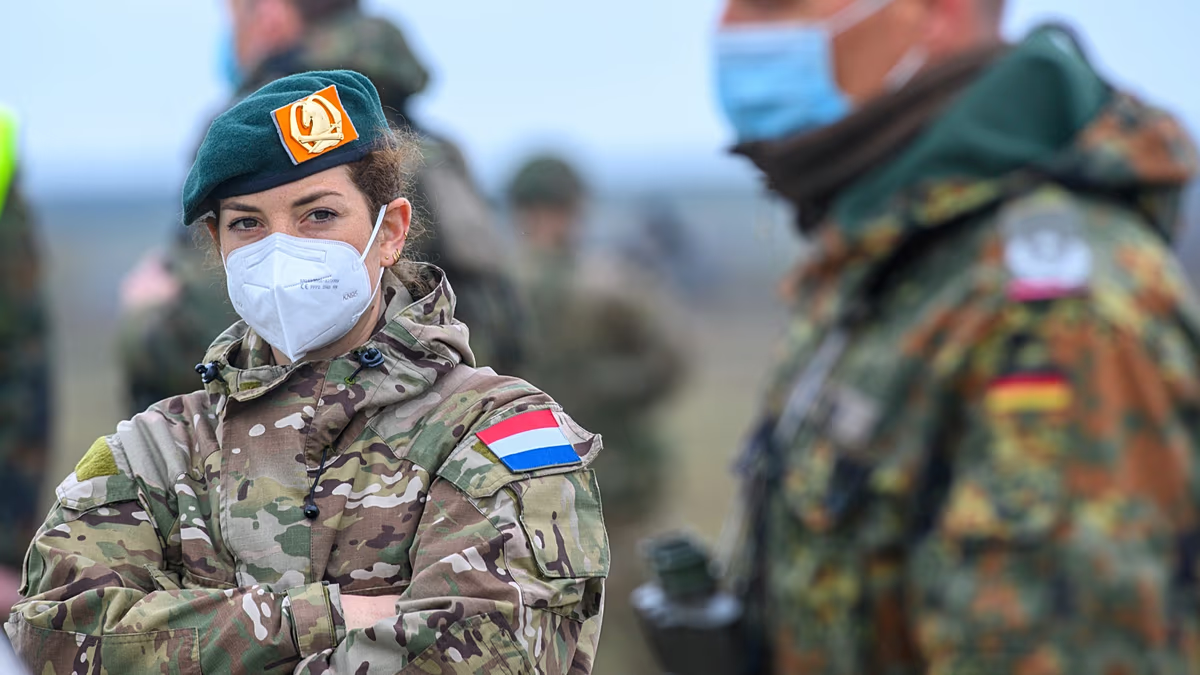

A new German government agreement to introduce a voluntary model of military service is fueling a national conversation about women in the armed forces and their potential role in national defense. The plan, reached after months of deliberation, requires all 18-year-old men to register and undergo medical screenings, with a questionnaire to gauge interest in full enlistment. While women are welcome to volunteer, they are not subject to the same mandatory requirements, sparking debate and, in some cases, misinformation online.
The initiative aims to bolster the Bundeswehr through voluntary recruitment, but provisions exist for potential random selection if volunteer numbers fall short. This has led to questions about fairness and equality, particularly regarding the exclusion of mandatory registration for women. Social media has seen a surge in discussion, ranging from legitimate criticism to inaccurate claims about the policy.
Why Aren’t Women Obliged to Serve in the Armed Forces?
Many are questioning why women aren’t held to the same standards as men in this new system. The answer lies within Germany’s constitution, specifically Article 12a of the Basic Law. This article states that men “may be required to perform service” in the military or civil defense organizations, but makes no mention of women.
However, this doesn’t mean women are barred from serving. Since 2001, following a ruling from the European Court of Justice, women have been allowed to fill all military roles, including combat positions. Currently, there are over 24,000 female soldiers within the Bundeswehr, representing approximately 13% of the total military personnel.
Legal scholars and feminist advocates point out a potential contradiction between Article 12a and Article 3(2) of the Basic Law, which guarantees equal rights for both men and women. Others argue that differing physical capabilities between sexes could be reinforced by compulsory service for men but not women.
Friedrich Merz, a prominent German politician, has signaled openness to amending the constitution to include women in mandatory service. However, such a change faces significant political hurdles. It would necessitate a two-thirds majority in the Bundestag, requiring support from across the political spectrum, including potentially conflicting viewpoints from both the far-left and far-right parties.
European Trends in Military Conscription
Germany’s approach differs from some of its European neighbors who have moved towards universal conscription. A growing number of countries, particularly in Scandinavia, are implementing systems that apply to both men and women.
Norway introduced mandatory military service for women in 2015, becoming the first NATO nation to do so. Sweden followed suit in 2017 as part of a broader reintroduction of conscription after a period of suspension. Denmark recently updated its conscription policy, planning to implement a lottery-style system including women by 2026.
The Netherlands technically maintains a law for female conscription, enacted in 2018, but it remains largely symbolic as mandatory service hasn’t been actively enforced since 1997. The Dutch Ministry of Defence provides further information on their current military policies.
While Germany isn’t alone in having a predominantly voluntary system, many European countries still maintain a voluntary path for women even within broader conscription frameworks. In Austria, Cyprus, Estonia, Finland, Greece, Latvia, Lithuania, Switzerland, and Ukraine, women can volunteer for military roles but are not legally obligated to do so.
Similarly, Belarus, Russia, Turkey, and Croatia (starting in early 2026) allow voluntary female enlistment alongside mandatory service for men. Meanwhile, countries like France, Poland, Spain, and the UK are increasingly opening combat roles to women, with the UK lifting all restrictions in December 2018.
The debate surrounding women in the armed forces is complex, touching on constitutional law, gender equality, and practical considerations of military readiness. As Germany moves forward with its new recruitment model, the question of whether to amend the constitution to include women will likely remain a prominent topic of discussion. The evolving landscape of European defense policies suggests this conversation will continue to gain momentum, and it will be important to follow how Germany navigates these challenges in the coming years.