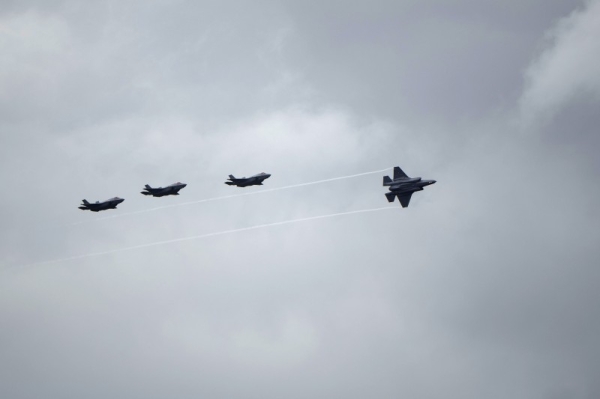

The United States has approved the sale of F-35 fighter jets to Saudi Arabia, President Trump announced, a move expected to significantly bolster the Kingdom’s air defense capabilities. The agreement, revealed ahead of Crown Prince Mohammed bin Salman’s visit to Washington, positions Saudi Arabia as the 21st nation to acquire the advanced aircraft. This development signals a deepening strategic partnership between the United States and Saudi Arabia in a region facing complex security challenges.
The prospective deal has been closely watched, especially given past congressional concerns regarding the Kingdom’s human rights record and involvement in the Yemen conflict. While the Biden administration initially signaled a pause on certain arms sales to Saudi Arabia, this decision represents a shift toward reinforcing existing security commitments. The specific number of aircraft and total value of the agreement remain undisclosed, though impacts on regional military balance and defense industry contracts are anticipated.
The Capabilities of the F-35 Fighter Jet
The F-35, manufactured by Lockheed Martin, is widely considered the most advanced multirole combat aircraft currently in operational service. Its core strengths lie in its low observability – or stealth – capabilities, advanced sensor fusion, and ability to act as a networked command and control node. This allows pilots to gather and interpret data from various sources, gaining an advantage in complex aerial engagements.
Key Technological Advantages
The F-35’s stealth technology is achieved through its design and materials, making it difficult to detect by radar. Its sophisticated sensor suite combines radar, infrared, and electronic warfare systems, providing pilots with comprehensive situational awareness, according to Lockheed Martin documentation. Furthermore, the jet’s data-sharing capabilities allow it to seamlessly integrate with other military assets – air, land, and sea – enhancing overall operational effectiveness.
This capability significantly differentiates the F-35 from Saudi Arabia’s existing fleet, which includes F-15SA fighters, Eurofighter Typhoons, and older Tornado aircraft. While these platforms remain potent, they lack the stealth and integrated sensor technology of the F-35, capabilities increasingly vital for modern warfare.
Strategic Implications for Saudi Arabia and the Region
The potential acquisition of the F-35 aligns with Saudi Arabia’s long-term military modernization goals, reflecting its efforts to diversify its defense procurement and address emerging regional threats. According to a report by the International Institute for Strategic Studies, the Kingdom faces persistent security challenges stemming from regional instability and ongoing conflicts.
Access to the F-35 is generally reserved for close U.S. allies, suggesting a strengthening of the strategic relationship between Washington and Riyadh. However, this decision follows years of fluctuating relations, marked by disagreements over oil policy, human rights, and the war in Yemen.
Additionally, the sale has triggered debate regarding the potential for an arms race in the Middle East. Neighboring countries, such as Iran, may react by seeking to acquire advanced weaponry of their own, potentially escalating tensions in the region. The United Arab Emirates, another regional power, has also expressed interest in acquiring the F-35, and the outcome of their request may be linked to the Saudi deal.
The approval of this sale represents a notable geopolitical development. Previously, restrictions on technology transfer were a significant hurdle. While details remain limited, industry analysts suggest the agreement includes provisions for training, maintenance, and potential co-production of components, though the scope of these aspects is yet to be fully clarified.
Other nations currently operating the F-35 include the United Kingdom, Italy, Japan, and South Korea, forming a broad international coalition of users. This global network provides opportunities for interoperability and security cooperation, strengthening the overall effectiveness of the platform. The increased regional presence of the F-35 may also affect existing power dynamics, introducing a new level of technological complexity to the Middle East.
The next step in the process involves Congressional review, where lawmakers will assess the sale against various criteria, including human rights concerns and regional security implications. While the executive branch has approved the sale, Congressional opposition could still delay or even block the deal. The timeline for final approval and delivery remains uncertain, dependent on the outcome of this review and ongoing negotiations. Observers will be closely monitoring Congressional hearings and statements for indications of potential roadblocks or amendments to the agreement.
The potential approval of defense contracts for Lockheed Martin and related suppliers is also being closely followed by industry analysts. Further, the impact on U.S. strategic partnerships in the region, particularly with Israel, which maintains a qualitative military edge, will be a key consideration moving forward.