
Macron put nuclear deterrents on the table in an interview published late on Saturday, prompting other European nations to weigh in.
Macron urges ‘open’ debate on nuclear deterrents being used to defend the EU, as stated in an interview published by regional outlets from the Ebra press group. France will “uphold its distinctiveness but is willing to make a greater contribution to Europe’s defence.”
This marks the latest in a series of addresses in recent months during which he has underscored the necessity for a European-led defence strategy.
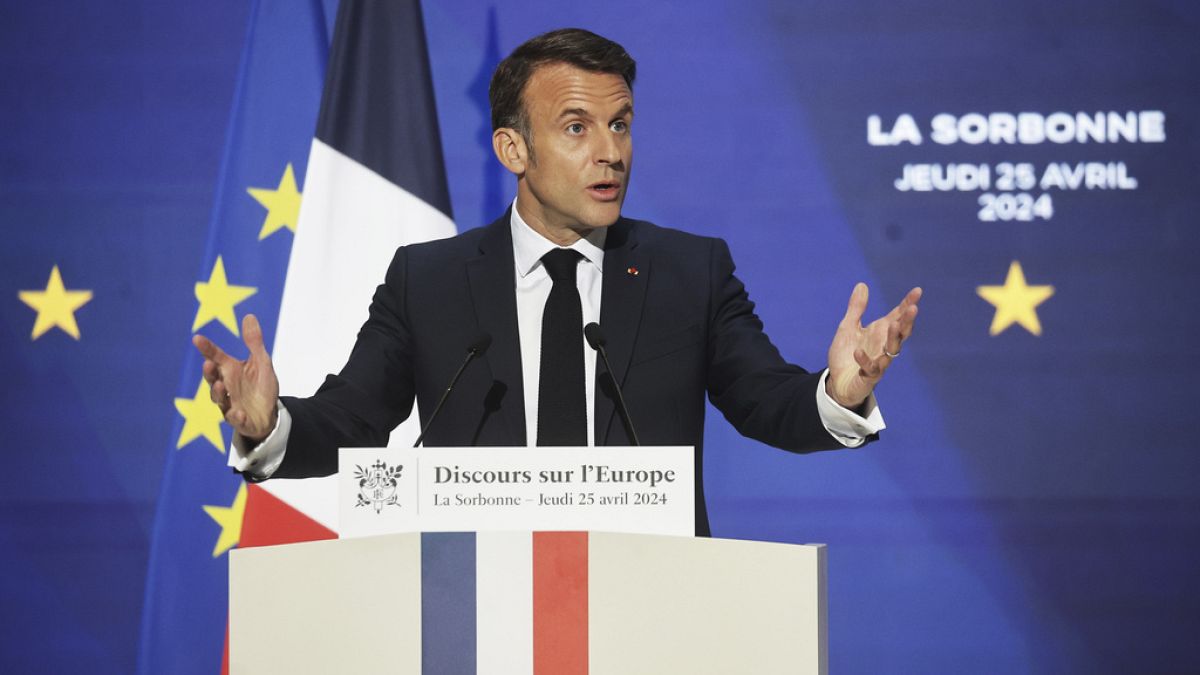
A few days earlier during a speech at Sorbonne University in Paris, Macron warned that Europe could ‘die’ if it failed to build a robust defence. He also cautioned that Europe was confronted by an existential threat posed by Russian aggression going on to say that”being credible also involves possessing long-range missiles to deter the Russians.”
France’s resurgence in nuclear
Emmanuel Macron has championed the revival of France’s nuclear program as a central focus of his second presidential term.
With the emphasis on job creation, green investments, and advancements in mini-reactors, the challenges accompanying this nuclear resurgence are manifold.
The President of the Republic had underscored this commitment during his re-election campaign in May 2022. Months earlier, during a visit to the Arabelle turbine manufacturing site in Belfort, Macron unveiled an ambitious nuclear program.
According to the President, this is the main solution to meet the burgeoning electricity demand driven by increased electrification, to achieve carbon neutrality by 2050, and sustain competitive electricity prices to support French businesses.
Macron has unabashedly hailed nuclear power as a “technology of the future”. France’s current fleet of electricity production reactors comprises 56 pressurised water reactors (PWR), classified as “generation II”, along with an EPR (European Pressurised Water Reactor) reactor presently under construction in Flamanville, Manche, designated as “generation III” .
In January, President Emmanuel Macron declared his intention to outline “the primary directions for the next 8” EPR reactors from the summer onwards, as part of the nuclear power revival, following the launch of six new EPR reactors, during a press conference.
Nuclear controversy in Germany
Whilst 65 to 70 percent of electricity in France is generated by nuclear, Germany’s figure was only 1.4 percent in 2023. It is indicative of a complicated relationship between Germany’s political parties and nuclear power.
Amid concerns over gas supplies following Russia’s invasion of Ukraine, three policy options were considered by the government: extending the use of existing nuclear fuel, purchasing new fuel elements, or reopening the recently shut-down plants. The Green Party strongly opposed restarting nuclear power stations.
The handling of Germany’s nuclear phase-out during the 2022 energy crisis has drawn scrutiny towards the country’s economic and environment ministries, both under Green Party leadership, for their approach to closing the last three nuclear power plants.
German Federal Minister for Economic Affairs and Climate Action, Robert Habeck, found himself redirected to the Bundestag’s energy committee to defend his controversial policy amid the energy crisis.
Despite internal discussions and assessments supporting the feasibility of extending the nuclear plants’ lifespans, a change in direction occurred within the environment ministry, citing “reasons of nuclear safety”.
Minister Habeck defended his ministry’s actions, emphasising the need to focus on replacing Russian natural gas rather than relying on nuclear energy for electricity.
The decision to extend the life of the last three nuclear power plants was eventually reached several months later, reflecting a compromise pushed by the liberal Free Democratic Party (FDP) .
The handling of this matter has faced criticism from Germany’s conservative opposition, who argue that the process lacked transparency and openness.
Spain’s ongoing debate
Spain’s energy strategy remains a subject of debate, with differing viewpoints on the role of nuclear and renewable energies in achieving sustainability and energy independence.
 ADVERTISEMENT
The Spanish government announced in December plans to phase out the country’s nuclear reactors, with the first plant shutdown scheduled for 2027.
The energy landscape is influenced by Russia’s strategic leveraging of its gas production capacity and the disruption caused by disputes such as the recent gas supply cut-off by Algeria to Morocco, affecting one of Spain’s gas supply routes.
Greenpeace Spain calls for an accelerated transition away from nuclear energy, critiquing Spain’s energy plan for not prioritising a rapid shift towards 100% renewable energy.
José Luis García, responsible for Greenpeace’s Climate Emergency program, challenges the classification of nuclear energy as ‘green’, emphasising the need to address broader environmental risks associated with nuclear power .
While France looks to bolster its energy security by embracing nuclear power alongside renewables, Spain remains steadfast in its commitment to achieve complete denuclearisation by 2035, as outlined in its Comprehensive National Energy and Climate Plan 2021-2030 (Pniec). Including two nuclear powerplants 100 kilometres from the Portuguese border.
ADVERTISEMENTPortugal’s phasing out nuclear, Italy phasing in
In March this year, Portugal took a significant step towards dismantling its long-serving nuclear reactor, which had been instrumental in scientific research and education for over five decades.
This marks the conclusion of an era that once envisioned multiple nuclear power plants in Portugal for electricity generation. Now, detailed plans are underway for the dismantling process, expected to span a decade.
Portugal has taken a firm stance against nuclear energy, with Minister of Environment and Climate Action, João Pedro Matos Fernandes, highlighting its perceived shortcomings during the 26th United Nations climate conference (COP26) in Glasgow.
He emphasised that nuclear energy is deemed unsafe, unsustainable, and economically burdensome.
Italy’s nuclear history saw all four plants closed following a 1990 referendum. A subsequent attempt to reintroduce nuclear power was halted by a 2011 referendum.
ADVERTISEMENTItaly’s Chamber of Deputies has launched an inquiry into the role of nuclear energy in its energy transition. The country, the only G7 nation without operating nuclear power stations, shut down its last plant over 30 years ago.
The inquiry aims to explore nuclear energy’s potential contribution to Italy’s decarbonisation by 2030 and climate neutrality by 2050. It was supported by pro-nuclear members but faced abstention from others.
Minister of Environment in Italy, which is hosting the G7 meeting this year, said in a recent speech, “We have continued to work with important private companies both on the fission front, therefore on the new generation NUCLEAR with small reactors, and on the fusion front”
Last March, the Minister of Infrastructure and Transport and Deputy Prime Minister Salvini also said that a modern and industrialised country “cannot say no to nuclear energy.”
Read the full article here